| M-Type |
- Iron-nickel alloys (taenite, kamacite)
- Troilite (Fe
Asteroids are remnants of the early Solar System, preserving clues about planetary formation and the dynamic processes that shape their internal structures. Their composition and physical properties result from a combination of primordial accretion, thermal evolution, and collisional history. Differentiation—driven by partial melting and crystallization—alters their internal composition, while volatile compounds influence mineralogical diversity. Collisional fragmentation and accretion further modify their porosity, regolith development, and surface morphology, distinguishing them from primordial chondritic bodies.
The geological evolution of asteroids reflects their thermal and mechanical histories, with key processes including radiogenic heating, impact-induced shock metamorphism, and the retention of volatiles. These mechanisms interact to produce a spectrum of asteroid types, from undifferentiated rubble piles to fully differentiated planetesimals with metallic cores and silicate mantles.
Asteroid differentiation occurs when sufficient heat causes partial melting of their parent bodies, leading to the separation of materials based on density and melting point. This process is primarily driven by:
- Radiogenic heating from the decay of short-lived isotopes (e.g., ^26Al, half-life ~0.7 Myr), which were abundant in the early Solar System.
- Impact-induced heating, where high-velocity collisions generate localized melting and vaporization.
- Gravitational compression, which raises internal temperatures in larger bodies (>50–100 km in diameter).
Partial melting triggers crystallization, with denser metallic iron-nickel alloys (forming cores) sinking to the center, while silicates (mantles) and residual melts (crusts) stratify above. Blockquote: "Differentiation in asteroids is analogous to terrestrial planetary formation but occurs on smaller scales, with timescales of millions to tens of millions of years." Observations of differentiated asteroids (e.g., 4 Vesta, a protoplanet with basaltic crust and olivine-rich mantle) confirm this model, supported by spectral data from missions like Dawn and meteoritic evidence (e.g., HED meteorites linked to Vesta). The efficiency of differentiation depends on:
- Parent body size: Larger asteroids (>200 km) retain heat longer, enabling complete or near-complete differentiation.
- Compositional heterogeneity: Carbonaceous chondrites (e.g., C-type asteroids) may lack sufficient radiogenic heat sources, remaining undifferentiated.
- Volatile content: The presence of water or carbon compounds can lower melting temperatures, facilitating differentiation even in smaller bodies.
Collisional Fragmentation and Accretionary Evolution
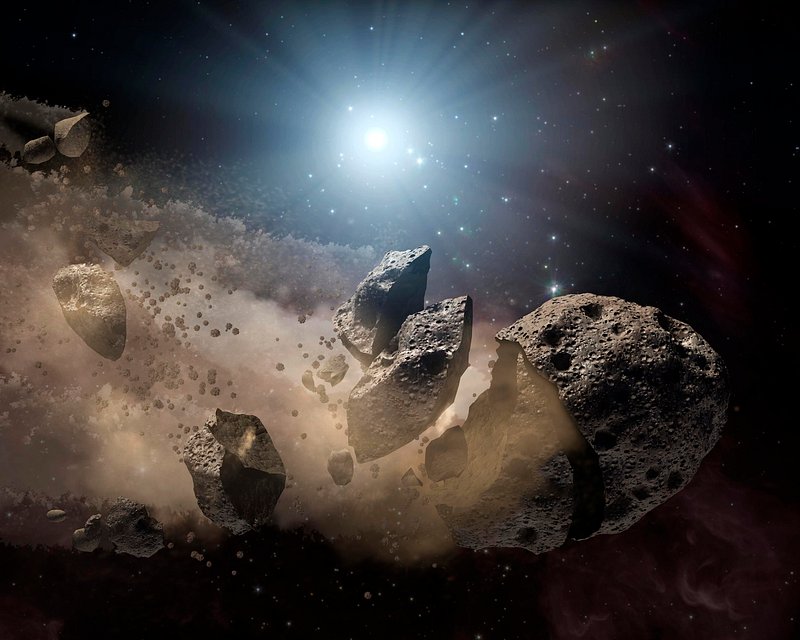
Asteroids undergo continuous modification through catastrophic and gardening-scale collisions, which dictate their long-term physical and compositional evolution. Collisional processes include:
- Catastrophic disruption: High-velocity impacts (>1 km/s) shatter parent bodies into fragments, forming asteroid families (e.g., Eos family, Koronis family).
- Gardening impacts: Lower-energy collisions (<500 m/s) pulverize surfaces, creating regolith layers (loose, fragmented material) observed on 253 Mathilde and 433 Eros.
- Accretionary rebound: Debris from collisions may re-accrete into smaller bodies (e.g., rubble-pile asteroids like 25143 Itokawa), characterized by high porosity (30–50%).
Table: Collisional Effects on Asteroid Properties | Process | Physical Outcome | Example Asteroids |
|---|
| Catastrophic disruption | Family formation, size-frequency distribution | Flora, Themis families |
| Regolith development | Surface layering, reduced albedo | Bennu, Ryugu |
| Porosity increase | Low bulk density, irregular shapes | 25143 Itokawa (porosity ~40%) |
| Shock metamorphism | Maskelynite, diaplectic glass formation | L chondrite parent bodies |
Near-Earth objects (NEOs) often exhibit signs of recent fragmentation, such as binary asteroids (e.g., 624 Hektor, a contact binary with a satellite) or contact binaries (e.g., 29075 1950 DA). These systems arise from rotational fission or post-impact re-accretion, with spin rates exceeding ~2–3 hr^-1 triggering material loss.
Hydrated Minerals and Volatile Retention in Asteroids
Hydrated minerals (e.g., phyllosilicates, carbonates) and water ice are prevalent in primitive asteroids, particularly C-type and D-type bodies, indicating past or present aqueous alteration. Their formation involves:
- Parent body aqueous alteration: Liquid water reacts with silicates at temperatures <400°C, producing serpentine, smectite, and carbonates (e.g., CM/CI chondrites).
- Impact-delivered volatiles: Comets and carbonaceous chondrites may introduce water ice or hydroxyl (OH)-bearing compounds via low-velocity accretion.
- Space weathering: Solar wind protons implant into surfaces, forming hydroxyl groups (detected in 101955 Bennu’s spectral signatures).
Key mechanisms for volatile retention:
- Low-temperature environments: Asteroids in the outer belt (e.g., 1 Ceres) retain ice in permanently shadowed craters or subsurface layers.
- Insulating regolith: A thick dust layer (e.g., 24 Themis) can preserve volatiles by limiting thermal escape.
- Amorphous ice stabilization: Non-crystalline ice remains stable at temperatures >100 K, as observed in 65 Cybele spectra.
Blockquote: "The detection of hydrated minerals in asteroids like 243 Ida (via Galileo) and Ceres (via Dawn) confirms that aqueous processes were active during the first few million years of Solar System history, even in small bodies." Examples of hydrated asteroid classes:
- C-type (carbonaceous): Rich in phyllosilicates (e.g., 1 Ceres, 2 Pallas).
- G-type (metallic-carbonaceous): Contain magnetite and serpentine (e.g., 10 Hygiea).
- D-type (primitive): Possess organic-rich hydrated minerals (e.g., 624 Hektor).
Volatiles in asteroids also influence their spectral properties, with absorption features at 2.7–3.1 µm (OH/stretching modes) and 6 µm (water ice). Missions like Hayabusa2 (sampled 162173 Ryugu) and OSIRIS-REx (Bennu) have returned material confirming the presence of hydrous silicates and organic compounds, linking asteroid volatiles to the delivery of water and prebiotic molecules to Earth.

Organic and Volatile Compounds in Asteroids
Asteroids serve as cosmic repositories of organic and volatile compounds, offering critical insights into the chemical precursors of life and the early solar system’s evolution. Carbon-rich asteroids, in particular, contain a diverse array of prebiotic molecules—such as amino acids and polycyclic aromatic hydrocarbons (PAHs)—that challenge traditional views of abiotic chemistry. Meanwhile, volatile compounds like CO₂, CO, and ammonia exhibit distinct profiles depending on thermal processing, with primitive asteroids preserving near-original compositions while altered bodies reflect aqueous or metamorphic histories. Sample return missions, including Hayabusa2 and OSIRIS-REx, have provided direct evidence of these compounds, reshaping models of planetary accretion and the delivery of volatiles to Earth.The detection of organic molecules in asteroids underscores their role as potential seedbeds for life’s emergence. Spectroscopic and laboratory analyses reveal that carbonaceous chondrites—such as the Murchison meteorite—contain over 70 amino acids, including those essential for protein synthesis (e.g., glycine, alanine). Polycyclic aromatic hydrocarbons (PAHs), identified in spectra of asteroids like 24 Themis, suggest complex organic synthesis in the early solar nebula, possibly through UV irradiation or catalytic reactions on dust grains.
Prebiotic Organic Molecules in Carbon-Rich Asteroids
Carbonaceous chondrites, particularly CI and CM groups, host the most diverse suite of prebiotic organics, with concentrations exceeding terrestrial abiotic sources. Key findings include:- Amino Acids: The Murchison meteorite (CM2) contains ~70 amino acids, with enantiomeric excesses (e.g., ~15% L-enrichment in isovaline) hinting at chiral selectivity mechanisms in space. The Tagish Lake meteorite (C2 ungrouped) exhibits even higher abundances (~100s of ppm), suggesting parent-body aqueous alteration enhanced synthesis.
- Polycyclic Aromatic Hydrocarbons (PAHs): Infrared spectroscopy of 24 Themis (C-type) and 162173 Ryugu (sampled by Hayabusa2) reveals PAH signatures, including perylene and coronene, formed via photolytic processing of simpler hydrocarbons in the protoplanetary disk.
- Nitrogen-Heterocycles: Purines (e.g., uracil, xanthine) and pyrimidines (e.g., cytosine) detected in Orgueil (CI1) suggest RNA-like precursors, supporting the "RNA World" hypothesis for early genetic systems.
- Aliphatic Hydrocarbons: Alkanes and alkenes in Allende (CV3) indicate Fischer-Tropsch-type synthesis on parent bodies, driven by CO + H₂ reactions under hydrothermal conditions.
Laboratory simulations (e.g., Miller-Urey experiments with cosmic ice analogs) confirm that UV photolysis of methanol, ammonia, and water can produce these molecules, reinforcing asteroid surfaces as plausible sites for prebiotic chemistry.
Volatile Composition: Primitive vs. Thermally Altered Asteroids
Volatiles in asteroids reflect their thermal history, with primitive bodies retaining near-solar abundances while altered asteroids show depletion or fractionation. Sample return missions (Hayabusa2, OSIRIS-REx) and infrared spectroscopy (e.g., Spitzer, JWST) provide direct comparisons:- Primitive Asteroids (e.g., Ryugu, Bennu):
- CO₂/CO Ratios: Near ~1:1, consistent with solar nebula compositions and minimal aqueous alteration.
- Ammonia (NH₃): Detected in Ryugu’s hydrated minerals, suggesting low-temperature condensation from icy planetesimals.
- Water Ice: Bennu’s surface shows hydroxyl (OH) bands, but no pure ice, implying phyllosilicate formation via fluid-rock interactions at ~50–100°C.
- Noble Gases: Helium and neon in Ryugu’s samples match solar wind implantation, confirming direct exposure in the outer asteroid belt.
- Thermally Processed Asteroids (e.g., Vesta, 4 Vesta):
- CO₂ Depletion: ~90% loss relative to CI chondrites, attributed to thermal metamorphism at >600°C during differentiation.
- CO Dominance: CO/CO₂ > 2:1, linked to carbonate decomposition (e.g., dolomite → CO + CaO).
- Nitrogen Loss: NH₃ and HCN undetected, replaced by fixed nitrogen (e.g., nitriles) in organic residues.
- Volatile Retention in Trapped Phases: Apatite and sulfides in Eucrites (Vesta’s crust) preserve trace CO₂ and H₂O, indicating late-stage fluid mobility.
Thermal Alteration Indicators: | Parameter | Primitive Asteroids | Altered Asteroids |
|---|
| CO₂/CO Ratio | ~1:1 (solar) | <0.5 (fractionated) |
| Ammonia (NH₃) | Detected (hydrated minerals) | Absent (devolatilized) |
| Water Content | ~5–10% (hydrous silicates) | <1% (anhydrous pyroxenes) |
| Noble Gases | Solar wind implanted | Degassed (radiogenic dominance) |
Comet-like asteroids (e.g., D-type, P-type) exhibit volatile profiles akin to comets, with implications for planetary migration models and outer solar system delivery mechanisms. Key volatiles include:
Significant Volatile Compounds in Comet-Like Asteroids
- Carbon Monoxide (CO): ~50–80% of total carbon volatiles in 67P/Churyumov-Gerasimenko (Rosetta mission), suggesting low-temperature condensation from CO-rich ices.
- Carbon Dioxide (CO₂): ~10–30%, often trapped in clathrates with H₂O, indicating co-condensation in the trans-Neptunian region.
- Methane (CH₄): ~1–5%, detected in Centaurs (e.g., 29P/Schwassmann-Wachmann 1), implying amorphous ice matrices as a reservoir.
- Ammonia (NH₃) and HCN: ~0.1–1%, critical for prebiotic nitrogen fixation; NH₃:HCN ratios in comets (~3:1) suggest solar nebula inheritance.
- Hydrogen Cyanide (HCN): ~0.01–0.5%, a precursor to adenine and glycine; its isotopic ratios (¹⁴N/¹⁵N) match interstellar medium values.
- Methanol (CH₃OH): ~1–10%, formed via UV-driven hydrogenation of CO on dust grains; deuterium enrichment (D/H ~ 10⁻³) links to cold molecular clouds.
Planetary Formation Theories Supported by Volatile Data:
- Grand Tack Hypothesis: The CO₂/CO ratios in inner-belt asteroids (e.g., 4 Vesta) align with Jupiter’s inward migration, which would have scattered CO-rich planetesimals into the asteroid belt.
- Nice Model: NH₃ and HCN abundances in C-type asteroids suggest Neptune’s outward migration delivered nitrogen-rich ices from the Kuiper Belt.
- Peebles Model: Volatile gradients (e.g., H₂O ice line at ~2.7 AU) explain why carbonaceous chondrites (e.g., Ryugu) contain both hydrated minerals and CO₂ clathrates, implying formation across the ice line.
Spectroscopic Evidence:
- JWST’s NIRSpec detected CO₂ absorption bands in 162173 Ryugu, confirming aqueous alteration without thermal loss, contrary to earlier models.
- ALMA observations of dusty debris disks (e.g
Spectroscopic and Remote Sensing Techniques for Asteroid Compositional Analysis
Spectroscopic and remote sensing techniques form the cornerstone of modern asteroid science, enabling non-invasive characterization of surface compositions, mineralogy, and physical properties from ground-based and spacecraft observations. These methods leverage electromagnetic radiation across multiple wavelengths—visible, infrared (IR), and radar—to identify absorption features, thermal emissions, and scattering signatures unique to specific minerals and compounds. By integrating data from telescopes, planetary radar systems, and orbital missions, researchers reconstruct asteroid compositions without physical sampling, offering insights into their origins, evolutionary processes, and potential resource utilities.The effectiveness of these techniques hinges on the interaction between electromagnetic waves and asteroid surfaces. Minerals such as olivine, pyroxene, and hydrated silicates exhibit distinct spectral fingerprints in the visible and near-infrared (NIR) ranges, while metallic asteroids like 16 Psyche reveal their properties through radar polarimetry and thermal inertia measurements. Radar observations further probe sub-surface structures and metallic abundances, complementing spectroscopic data to build a holistic understanding of asteroid geology.
Spectral Analysis in Visible and Near-Infrared (VNIR) Ranges
Visible and near-infrared spectroscopy (0.4–2.5 µm) is the most widely used method for classifying asteroid compositions, as it directly targets the diagnostic absorption bands of silicates, metals, and organics. The technique relies on the principle that specific minerals absorb light at characteristic wavelengths due to electronic transitions in their crystal structures. For example:
- Olivine ((Mg,Fe)₂SiO₄) exhibits a broad absorption feature near 1 µm and a weaker band at 2 µm, attributable to Fe²⁺ charge transfers.
- Pyroxenes (e.g., enstatite MgSiO₃, ferrosilite FeSiO₃) display a prominent 1 µm band and a second feature near 2 µm, with band depth and position indicating iron content and crystal structure (ortho- vs. clinopyroxene).
- Hydrated silicates (e.g., phyllosilicates, carbonaceous chondrite matrices) show absorption near 0.7 µm (UV slope) and a broad 3 µm feature due to hydroxyl (OH) and water (H₂O) stretching vibrations.
Ground-based spectrographs (e.g., MIT-UHIR, SpeX, X-Shooter) and space-based instruments (e.g., NASA’s OSIRIS-REx Visible and Infrared Spectrometer (OVIRS)) acquire reflectance spectra by comparing asteroid light to a solar analog standard. The resulting reflectance spectra are normalized to account for solar illumination and geometric effects, then analyzed for:
- Band centers and depths (indicative of mineral stoichiometry).
- Spectral slope (suggesting space weathering or regolith maturity).
- Albedo variations (linked to surface grain size and composition).
Key Limitation: VNIR spectroscopy is surface-sensitive (penetrating only ~10–100 µm) and may be obscured by regolith mixing or thin dust layers. Additionally, overlapping absorption features (e.g., pyroxene and olivine) require high signal-to-noise ratios for unambiguous identification.
Infrared Thermography and Thermal Emission Spectroscopy (3–50 µm)
Infrared observations extend beyond reflectance into the thermal emission regime, where asteroids radiate heat absorbed from solar irradiation. This method is critical for:
- Determining surface temperatures and thermal inertia (a proxy for regolith properties).
- Identifying silicate and sulfide minerals via reststrahlen bands (emission peaks at ~8–12 µm for pyroxene, ~10–15 µm for olivine).
- Detecting volatile outgassing (e.g., water ice sublimation in main-belt comets like 289P/Blanpain).
Space-based telescopes (Spitzer, Akari, NEOWISE) and ground-based facilities (VLT/VISIR, SOFIA/FORCAST) measure thermal emission spectra to constrain:
- Particle size distribution (fine regolith cools faster than coarse material).
- Presence of metals/sulfides (e.g., troilite (FeS) exhibits a distinct 10 µm emission feature).
- Porosity and subsurface structure via thermal phase curves (variations in temperature with rotation).
Example: The M-type asteroid 16 Psyche shows a ~10 µm emission deficit, interpreted as a high metallic (Fe-Ni) content with minimal silicate contamination. However, recent James Webb Space Telescope (JWST) observations suggest unexpected olivine signatures, challenging pure-metal models.
Radar Observations: Probing Surface Texture and Metallic Properties
Planetary radar systems (Arecibo Observatory, Goldstone Solar System Radar, Green Bank Telescope) transmit high-power microwave pulses (3–10 cm wavelength) toward near-Earth asteroids (NEAs) and obtain delayed echoes to map surface roughness, shape, and composition. Key applications include:
- Delay-Doppler imaging: Reconstructs 3D asteroid shapes by analyzing echo delays (distance) and Doppler shifts (rotation).
- Polarimetric radar: Measures reflected signal polarization to distinguish between metallic, rocky, or icy surfaces (metals exhibit circular polarization ratios > 0.5).
- Bistatic radar: Uses separate transmit/receive stations to probe subsurface layers (e.g., detecting voids or boulders in rubble-pile asteroids like 25143 Itokawa).
Step-by-Step Radar Analysis Process:
1. Transmission: A 1–10 MW pulse (e.g., S-band at 2.38 GHz) is directed at the asteroid.
2. Echo Detection: Delayed returns (milliseconds to hours for distant objects) are recorded with high temporal resolution.
3. Signal Processing: Cross-correlation removes noise, and range-Doppler maps are generated.
4. Polarimetric Decomposition: The Stokes parameters (I, Q, U, V) quantify scattering mechanisms (e.g., volume vs. surface scattering).
5. Composition Inference: Metallic asteroids (e.g., 162173 Ryugu’s radar-dark regions) show low radar albedo, while carbonaceous asteroids exhibit high depolarization due to rough, porous surfaces.
Example: 16 Psyche’s radar observations reveal a smooth, metallic surface with radar albedo ~0.4, consistent with a Fe-Ni core but with unexpected low porosity (suggesting compaction or a differentiated interior).
Comparative Table of Spectroscopic and Radar Methods
| Method |
Wavelength Range |
Key Target Compounds/Properties |
Limitations |
|---|
| Visible/NIR Spectroscopy |
0.4–2.5 µm |
- Olivine, pyroxene (band centers at 1–2 µm)
- Hydrated silicates (OH/H₂O at 3 µm)
- Organics (e.g., polycyclic aromatic hydrocarbons, PAHs)
- Space weathering (reddening slope)
|
- Surface-limited (<100 µm depth)
- Overlapping bands require high S/N
- Sensitive to regolith mixing
|
| Thermal IR Spectroscopy |
3–50 µm |
- Silicate reststrahlen bands (8–12 µm)
- Metallic sulfides (e.g., troilite at 10 µm)
- Thermal inertia (regolith properties)
- Volatile outgassing (e.g., H₂O ice)
|
- Requires high-temperature contrast (best for NEAs)
- Atmospheric interference for ground-based observations
- Limited spatial resolution
|
| Radar (Delay-Doppler) |
3–1 
Laboratory Analysis of Meteorite Samples
Meteorites recovered from Earth’s surface serve as direct physical samples of asteroids, preserving records of their parent bodies’ formation, alteration, and thermal histories. Their classification relies on chemical, isotopic, and mineralogical analyses, which reveal processes occurring in the early solar nebula and subsequent asteroid differentiation. Noble gas studies, synchrotron radiation, and electron microscopy further unlock nanoscale features, including presolar grains, offering insights into the solar system’s primordial chemistry.
Classification of Meteorites Based on Chemical and Isotopic Signatures
Meteorites are categorized into three primary groups—chondrites, achondrites, and iron meteorites—each reflecting distinct parent-body processes. Chondrites, the most primitive, retain unaltered solar nebula material, while achondrites and irons indicate varying degrees of melting and differentiation. Isotopic analyses, particularly of oxygen (δ¹⁷O, δ¹⁸O), chromium (ε⁵⁴Cr), and tungsten (¹⁸²W/¹⁸⁴W), differentiate between carbonaceous, ordinary, and enstatite chondrites, as well as HED (howardite-eucrite-diogenite) and iron meteorite groups.Key classification criteria include:
- Oxygen isotopes: Carbonaceous chondrites (e.g., CI, CM) exhibit non-mass-dependent fractionation, distinguishing them from ordinary chondrites (e.g., H, L, LL), which plot along the terrestrial fractionation line.
- Trace element ratios: Refractory lithophile elements (e.g., Ca/Al, La/Yb) in chondrites reveal condensation sequences from the solar nebula, while achondrites show depletion patterns due to igneous processing.
- Cosmogenic nuclides: Exposure ages (e.g., ²¹Ne, ³⁸Ar) from cosmic-ray interactions constrain meteorite residence times on parent bodies or in space.
Example: The Allende meteorite (CV3) displays CAIs (Calcium-Aluminum-rich Inclusions) with isotopic anomalies (e.g., ¹⁶O-depleted), indicating heterogeneous nebular processes, while Orgueil (CI1) preserves solar abundances with minimal alteration.
Noble Gas Analysis and Solar Nebula Conditions
Noble gases (e.g., He, Ne, Ar, Xe) in meteorites provide direct probes into solar nebula conditions and thermal histories of parent bodies. These gases originate from:
- Solar wind implantation (e.g., ³He, ²¹Ne, ²²Ne), recorded in noble gas-rich chondrites like Allende and Murchison.
- Radiogenic decay (e.g., ⁴⁰Ar from ⁴⁰K, ¹²⁹Xe from ¹²⁹I), used to date meteorite formation.
- Trapped nebular gases, reflecting solar composition (e.g., Xe-HL, a heavy xenon component in carbonaceous chondrites).
Thermal processing indicators:
- Argon isotopes (⁴⁰Ar/³⁶Ar): High ratios in ordinary chondrites suggest parent-body heating, while low ratios in carbonaceous chondrites imply minimal alteration.
- Xenon anomalies (e.g., Xe-S, Xe-H): Isotopic excesses in Shallow (S) and Heavy (H) components trace presolar grains and nucleosynthetic processes in the solar nebula.
- Diffusion modeling: Temperature-time histories derived from noble gas release patterns (e.g., stepwise heating experiments) reveal peak metamorphic temperatures (e.g., 400–800°C for ordinary chondrites).
Formula: The cosmic-ray exposure age (CRE) is calculated via:
N = N₀(1 – e⁻λt), where N is the cosmogenic nuclide abundance, N₀ the saturation value, λ the decay constant, and t the exposure time.
Synchrotron Radiation and Electron Microscopy in Nanoscale Mineral Analysis
Advanced techniques like synchrotron X-ray diffraction (XRD) and transmission electron microscopy (TEM) resolve nanoscale mineral phases in meteorites, including presolar grains (e.g., SiC, graphite, diamond, silicates) and interstellar dust. These grains, formed before the solar system, preserve isotopic signatures (e.g., ¹²C/¹³C, ¹⁴N/¹⁵N) from stellar nucleosynthesis.Applications and findings:
- Synchrotron XRD: Identifies amorphous phases (e.g., glass with embedded metal and sulfide, GEMS) in primitive chondrites like Acfer 094, linked to aqueous alteration on parent bodies.
- TEM and STEM (Scanning TEM): Resolves nanodiamonds in Orgueil (CI1), attributed to supernovae or shock synthesis, with ¹⁵N-depletions indicating presolar origins.
- Nanoscale isotopic mapping: NanoSIMS (Secondary Ion Mass Spectrometry) coupled with FIB (Focused Ion Beam) tomography isolates ¹⁶O-rich silicates in CAIs, supporting supernova-triggered solar system formation.
Example: The Murchison meteorite (CM2) contains presolar silicon carbide (SiC) grains with ¹²C/¹³C > 100, consistent with AGB star outflows, while GEMS (Glass with Embedded Metal and Sulfides) in Renazzo (CR2) suggest nebular condensation followed by parent-body fluid activity.
Table: Key Nanoscale Phases and Their Implications| Mineral Phase | Host Meteorite | Detection Method | Implications |
|---|
| Presolar SiC grains | Murchison (CM2) | NanoSIMS + TEM | AGB star nucleosynthesis; solar nebula inheritance |
| GEMS (Glass) | Acfer 094 (CR2) | Synchrotron XRD + TEM | Nebular condensation + parent-body aqueous alteration |
| Nanodiamonds | Orgueil (CI1) | Raman spectroscopy + TEM | Supernova or shock synthesis; interstellar medium contribution |
| CAI melt inclusions | Allende (CV3) | FIB-SEM + NanoSIMS | Early solar system melting; isotopic heterogeneity in the protoplanetary disk |
Asteroid-Specific Case Studies
Asteroids exhibit remarkable diversity in composition, structure, and evolutionary history, offering critical insights into planetary formation and the distribution of materials within the solar system. Case studies of specific asteroids—such as those investigated by spacecraft missions or ground-based observations—reveal unique geological processes, formation environments, and the potential for preserving primordial solar system materials. Below, three pivotal case studies are examined: 253 Mathilde, a high-porosity C-type asteroid from the outer belt; 4 Vesta, the differentiated protoplanet whose basaltic crust links to HED meteorites; and 162173 Ryugu, a carbonaceous asteroid with a complex internal structure and organic-rich layers, as revealed by the Hayabusa2 mission.
The C-type asteroid 253 Mathilde, a member of the outer asteroid belt (approximately 3.4 AU from the Sun), was the first asteroid visited by a spacecraft (NEAR Shoemaker in 1997) and exhibited an unexpectedly high porosity (~50%), far exceeding typical values for solid rocky bodies. This extreme porosity suggests a formation history distinct from inner-belt asteroids, likely involving low-temperature accretion and collisional fragmentation rather than high-energy melting or differentiation.Key observations from the NEAR Shoemaker flyby include:
- Shape and Density: Mathilde’s irregular, elongated shape (59 × 47 × 45 km) and low bulk density (~1.3 g/cm³) imply a rubble-pile structure, where gravitational binding holds together loosely consolidated fragments.
- Surface Features: Its ancient, heavily cratered surface (e.g., the 90-km-wide Kant crater) indicates minimal geological activity, preserving a record of early solar system bombardment.
- Spectral Properties: Near-infrared reflectance spectra classify Mathilde as a primitive carbonaceous chondrite analog, with hydrated minerals (e.g., phyllosilicates) and organic compounds, consistent with outer belt conditions where ices and volatiles were more abundant.
Implications for Formation:
The high porosity of Mathilde supports models where low-velocity accretion in the outer belt allowed the retention of void spaces between planetesimals, preventing compaction. Additionally, its location beyond the snow line (where volatile ices condense) suggests it formed from icy and organic-rich materials, later losing volatiles through thermal or impact-driven processes. This case underscores the role of collisional evolution in shaping the structural diversity of asteroids, particularly in regions where differentiation was unlikely.
Dawn Mission Findings: 4 Vesta – Basaltic Crust and HED Meteorite Origins
The protoplanet 4 Vesta, the second-largest body in the asteroid belt (~525 km diameter), was the target of NASA’s Dawn mission (2011–2012), which revealed a differentiated interior with a basaltic crust, a rocky mantle, and a metallic core. Vesta’s geological complexity provides direct evidence for magmatic activity and the formation of achondritic meteorites (howardites, eucrites, and diogenites, collectively termed HED meteorites).Structural and Compositional Highlights:
- Crustal Composition: Vesta’s northern hemisphere features basaltic plains (e.g., Veneneia and Rheasilvia basins), formed by magma ocean crystallization ~4.5 billion years ago. These basalts are rich in plagioclase feldspar and pyroxene, matching the composition of eucrites.
- Impact History: The Rheasilvia basin (250 km diameter) and its central peak (Rheasilvia Mons) resulted from a catastrophic impact that excavated ~1% of Vesta’s mass, ejecting debris that became HED meteorites found on Earth.
- Mantle Exposure: Diogenites, a subtype of HED meteorites, represent orthopyroxene-rich cumulates from Vesta’s mantle, exposed by later impacts.
- Core and Magnetic Field: Dawn detected a weak remnant magnetic field, suggesting Vesta once had a partially molten core that later solidified, consistent with early differentiation models.
Link to HED Meteorites:
The howardite-eucrite-diogenite (HED) clan of meteorites are genetic fragments of Vesta, confirmed by:
- Oxygen isotope ratios matching Vesta’s crustal materials.
- Crater age dating (via Dawn’s imaging) aligning with the timing of HED formation (~4.5–4.4 billion years ago).
- Spectral matches between Vesta’s surface and laboratory analyses of HED samples.
This case demonstrates how asteroid differentiation can produce diverse meteorite types and provides a template for understanding the early thermal evolution of planetary bodies.
Illustration Prompt: Cross-Section of 162173 Ryugu (Hayabusa2 Target)
162173 Ryugu, a primitive C-type asteroid and the target of JAXA’s Hayabusa2 mission (2014–2020), exhibits a bilobate shape, a low-density structure, and a layered internal composition rich in organics and volatiles. Below is a descriptive prompt for a cross-sectional illustration of Ryugu, emphasizing its geological and compositional stratification:Title: Cross-Sectional Structure of Ryugu: Layered Composition and Regolith Distribution
View: Vertical slice through the asteroid’s equatorial plane, revealing internal layers and surface morphology. Key Features to Include:
1. Bilobate Shape and Spin Axis:
- Two distinct lobes connected by a narrow "neck," with a spin period of ~7.6 hours (fast rotation contributing to its "rubble-pile" stability).
- Equatorial ridge (up to 100 m high) formed by centrifugal forces redistributing regolith.
2. Layered Internal Structure (from surface inward):
- Regolith Layer (0–10 m depth):
- Dark, porous surface material (albedo ~0.04) composed of carbonaceous chondrite fragments, organics, and hydrated silicates.
- Boulders (up to 150 m in diameter) embedded in fine-grained matrix, indicating low-cohesion accumulation.
- Organic-Rich Zone (10–50 m depth):
- Dark, carbonaceous layers with aromatic hydrocarbons (e.g., polycyclic aromatic hydrocarbons, PAHs) and amino acids, as detected by Hayabusa2’s NIRS3 spectrometer.
- Phyllosilicates (e.g., serpentine, saponite) suggesting aqueous alteration during Ryugu’s parent body phase.
- Hydrated Mineral Layer (50–200 m depth):
- Hydrous silicates (e.g., smectite clays) formed by fluid-rock interactions in the parent body, later fragmented during collisions.
- Core Region (below 200 m):
- Undifferentiated mix of chondritic material, possibly with ice-bearing inclusions (now depleted or sublimated).
- Porosity gradient: Surface porosity ~50% (from ONC-T imaging), decreasing toward the center (~30–40%).
3. Geological Processes:
- Impact Gardening: Frequent micrometeorite impacts stir and homogenize the regolith, creating a uniform surface layer.
- Thermal Metamorphism: Evidence of mild heating (≤300°C) from short-lived radionuclides (e.g., ²⁶Al), altering organics but not fully dehydrating minerals.
- Outgassing Features: Bright patches (e.g., near the equator) may indicate exposed water ice or salt deposits from past cryovolcanic activity.
4. Sample Return Context:
- Hayabusa2’s touchdown sites (L08 and L08B) targeted fine-grained regolith rich in organics and hydrated minerals, as confirmed by near-infrared reflectance and X-ray fluorescence analyses.
- Dark, porous clasts in the samples suggest minimal terrestrial contamination, preserving Ryugu’s primordial composition.
Color and Texture Notes:
- Surface: Deep black with mottled dark red/brown hues (from tholins and iron oxides).
- Organic Layers: Dark gray to black, with iridescent sheen in polarized light (indicative of fine-grained carbonaceous material).
- Hydrated Zones: Greenish-blue tones (from phyllos
From the porous surfaces of 253 Mathilde to the basaltic crust of Vesta and the organic-rich layers of Ryugu, asteroids serve as cosmic time capsules, preserving the conditions of the solar system’s infancy. Their compositions—ranging from iron-nickel alloys to hydrated silicates and prebiotic organics—highlight the dynamic forces that govern planetary evolution. Advances in spectroscopy, meteorite analysis, and sample return missions continue to refine our understanding, reinforcing the idea that these celestial bodies are not merely relics but active participants in the story of how planets, and perhaps life, emerge. As research progresses, asteroids stand as silent witnesses to the processes that shaped our cosmic neighborhood, offering enduring lessons about the origins of matter itself.
FAQ
What are asteroids made of in a way that’s easy for kids to understand?
Asteroids are like space rocks made mostly of metal (like iron and nickel) and stone. Some are solid, while others are loose piles of rubble. They’re leftovers from when the solar system formed 4.6 billion years ago.
What materials make up asteroids in our solar system?
Asteroids in our solar system are primarily made of rock, metal (such as iron and nickel), or a mix of both. Some contain carbon-rich compounds, while others are icy or metallic. Their composition depends on where they formed in the solar system.
What are asteroids in the asteroid belt made of?
The asteroid belt’s objects are mostly rocky and metallic, with some containing carbon-based materials. The largest ones (like Ceres) are stony, while others are metal-rich or even icy. They vary based on distance from the Sun—closer ones are rockier, farther ones icier.
What elements are asteroids made of?
Asteroids contain elements like silicon, magnesium, iron, nickel, and aluminum, along with compounds such as silicates (rock-forming minerals) and sometimes carbon or sulfur. Metallic asteroids are rich in iron and nickel, while carbonaceous ones have organic molecules.
Are asteroids made of ice, and where do icy asteroids come from?
Some asteroids, especially in the outer solar system (like in the Kuiper Belt), contain ice—water, methane, or ammonia frozen solid. These are called icy or "dirty snowball" asteroids. They likely formed far from the Sun where temperatures were cold enough for ice to persist.
Could asteroids on Earth be made of the same materials as those in space?
Most asteroids that reach Earth as meteorites are made of the same materials found in space: rock (stony meteorites), metal (iron-nickel meteorites), or a mix. Some contain rare elements or organic compounds similar to those in space asteroids, but they’re often altered by Earth’s atmosphere or impact.
|
|
Leave a Comment
Comments are moderated before appearing. The data you submit is processed according to the Privacy Policy of Voltefac.