What Is Punjabi Language Culture And Global Influence
Table of Contents
- Punjabi as a Linguistic and Cultural Identity: Historical Roots and Evolution
- Ancient Origins and Early Indo-Aryan Foundations
- Medieval Period: Sikhism and the Standardization of Gurmukhi Script
- Colonial Era: British Documentation and Dialectal Fragmentation
- Key Milestones in Punjabi Language Evolution
- Punjabi in Religious and Literary Traditions
- Punjabi Language: Grammar, Script, and Scriptural Use
- Grammatical Structure of Punjabi
- Gurmukhi Script: Structure and Distinctive Features
- Punjabi in Sacred Texts: Poetic Meter and Theological Terminology
- Punjabi in Modern Media: Literature, Film, and Music
- Evolution of Punjabi Literature: From Classical Epics to Contemporary Voices
- Punjabi Cinema: Themes, Icons, and Global Influence
- Punjabi Music: From Folk to Global Fusion
- Punjabi Diaspora: Language Preservation and Adaptation
- Code-Switching and Linguistic Hybridization in Diaspora Punjabi
- Diaspora-Tailored Punjabi Media and Cultural Production
- Linguistic Innovations: Loanwords, Neologisms, and Phonetic Shifts
- FAQ
- What is Punjabi food and what makes it unique?
- What is the Punjabi language and where is it spoken?
- What is the current Punjabi month and date today?
- What is the Punjabi date today in Pakistan?
- What is the Punjabi religion and how does it differ by region?
- What does "Punjabi" mean?
The Punjabi language stands as a vibrant tapestry of history, faith, and artistic expression, deeply embedded in South Asia’s cultural identity. Originating from ancient Indo-Aryan roots, it has evolved through centuries of religious syncretism, imperial rule, and colonial transformation, shaping its distinct dialects, scripts, and literary traditions. From the sacred hymns of the Guru Granth Sahib to the rhythmic beats of bhangra and the poetic narratives of Heer Ranjha, Punjabi transcends linguistic boundaries, reflecting both regional pride and global diaspora resilience. Its grammatical intricacies—such as the vicholi case and honorific structures—alongside its dual scriptural forms, Gurmukhi and Shahmukhi, underscore its adaptability across religious and political landscapes. Today, Punjabi thrives in modern media, from blockbuster films like Dilwale Dulhania Le Jayenge to the fusion genres of diaspora artists, proving its enduring relevance in an interconnected world.
This exploration traces Punjabi’s journey from its linguistic and cultural foundations to its contemporary role as a bridge between tradition and innovation. Through historical timelines, scriptural analyses, and diaspora adaptations, the discussion reveals how Punjabi remains a dynamic force in literature, music, and identity, both within the Punjab region and among global communities. Its ability to absorb influences while preserving core elements offers a compelling case study in linguistic evolution and cultural preservation.
Punjabi as a Linguistic and Cultural Identity: Historical Roots and Evolution
The Punjabi language, spoken by over 125 million people globally, serves as a cornerstone of South Asian identity, transcending geographical and religious boundaries. Rooted in the ancient Indo-Aryan linguistic family, Punjabi evolved through millennia of migrations, conquests, and cultural syntheses, culminating in its modern forms—Western Punjabi (Pakistan) and Eastern Punjabi (India). Its development reflects broader socio-political shifts, from Vedic influences to Sikh religious reforms, Mughal administrative policies, and British colonial documentation efforts. Below, a structured exploration traces Punjabi’s linguistic trajectory alongside its cultural manifestations in religion, literature, and music, supported by a chronological framework of pivotal milestones.Ancient Origins and Early Indo-Aryan Foundations
Punjabi’s linguistic ancestry originates in the Vedic Sanskrit traditions of the Indo-Aryan migrations (c. 1500–500 BCE), which introduced proto-Punjabi dialects into the region now known as the Punjab. Early inscriptions, such as the Ashokan edicts (3rd century BCE), reference the region as Takshashila and Sapta-Sindhu, hinting at a distinct linguistic identity. The Rigveda and later Puranic texts mention tribal groups like the Trigartas and Malavas, whose languages contributed to the proto-Punjabi substrate.By the Mahabharata era (c. 400 BCE–400 CE), Punjabi absorbed Prakrit and Apabhramsa influences, diverging from Sanskrit while retaining key grammatical structures. The Kathiawari and Jangli dialects of this period laid the groundwork for later regional variations. A critical development occurred with the arrival of Buddhism and Jainism, introducing Pali and Ardhamagadhi loanwords, though these influences waned as Hinduism and later Sikhism dominated the cultural landscape.
Medieval Period: Sikhism and the Standardization of Gurmukhi Script
The 15th–16th centuries marked a transformative phase for Punjabi, driven by the Sikh religious movement founded by Guru Nanak (1469–1539). The Guru Granth Sahib, compiled between 1563 and 1604, became the foundational religious text of Sikhism and the first major work in Gurmukhi script, designed by Guru Angad (1504–1552). This script standardized Punjabi phonetics and grammar, distinguishing it from Persian and Arabic scripts used in Mughal administrative records.Key linguistic shifts during this era included:
The Mughal Empire’s (1526–1857) policies further stratified Punjabi dialects:
Colonial Era: British Documentation and Dialectal Fragmentation
British colonial rule (18th–20th centuries) accelerated Punjabi’s formalization while exacerbating dialectal divisions. The 1835 Gurmukhi-Persian controversy under Sir Henry Montgomery Lawrence led to the Perso-Arabic script’s dominance in official records, marginalizing Gurmukhi until the 1880s, when Bhai Vir Singh and Sant Singh revived its use. The 1890s Punjabi lexicon by Max Müller and George Grierson documented dialects systematically, categorizing them into Majhi, Malwai, Doabi, Pothwari, and Shahpuri variants.Colonial policies had contradictory effects:
Key Milestones in Punjabi Language Evolution
The following timeline outlines pivotal eras shaping Punjabi’s linguistic and cultural identity:| Era | Key Influences | Linguistic Changes | Cultural Contributions |
|---|---|---|---|
| Vedic Period (1500–500 BCE) | Indo-Aryan migrations, Vedic traditions | Proto-Punjabi dialects emerge; influence of Sanskrit and Prakrit | Oral epics (Mahabharata references to Punjab tribes) |
| Classical Period (400 BCE–1000 CE) | Buddhism, Jainism, Hindu bhakti movements | Apabhramsa substratum; early loanwords from Pali/Ardhamagadhi | Sufi poetry (Bulleh Shah), regional folk tales |
| Sikh Reformation (15th–17th centuries) | Guru Nanak, Guru Angad, Mughal rule | Gurmukhi script standardization; Persian/Arabic lexical integration | Guru Granth Sahib (1604); kirtan and shabad traditions |
| Colonial Period (18th–20th centuries) | British Raj, Partition (1947) | Dialectal codification (Majhi/Doabi); script controversies (Gurmukhi vs. Perso-Arabic) | Modern Punjabi literature (Puran Singh, Amrita Pritam); partition migration narratives |
| Post-Independence (1947–Present) | Global diaspora, digital media, linguistic nationalism | Standardization of Eastern/Western Punjabi; code-switching with Hindi/Urdu | Bhangra/Punjabi pop music (Daler Mehndi, AP Dhillon); Punjabi cinema (Sardar Udham) |
Punjabi in Religious and Literary Traditions
Punjabi’s cultural significance is most evident in its religious and literary heritage, which spans Sikh scriptures, Sufi poetry, and modern fiction.1. Sikh Religious Texts
The Guru Granth Sahib remains the most influential Punjabi work, composed in Brahma Gyan (a simplified Gurmukhi dialect) and including verses by Guru Nanak, Kabir, and Farid. Its 31 raags (melodic modes) reflect the language’s musicality, while Gurbani (devotional hymns) became the linguistic standard for Sikh rituals.
2. Sufi and Bhakti Literature
Sufi saints like Bulleh Shah (1680–1757) and Warish Shah (1722–1798) composed poetry in Punjabi and Saraiki, blending Islamic mysticism with folk traditions. Warish Shah’s Heer Ranjha (1766) is a quintessential romantic epic, while Bulleh Shah’s Kafir Koan critiques societal hypocrisy.
3. Modern Punjabi Literature
The 20th century saw Punjabi literature flourish under colonial resistance themes and post-partition trauma:

Punjabi Language: Grammar, Script, and Scriptural Use
Grammatical Structure of Punjabi
Punjabi grammar exhibits a blend of Indo-Aryan and Turkic-Persian influences, resulting in a system that prioritizes verb conjugations, noun cases, and honorifics to convey nuanced meanings. Unlike many Indo-Aryan languages, Punjabi retains a robust case system, with the vicholi (oblique case) marking indirect objects and locative relationships. Verb conjugations follow a tense-aspect-mood (TAM) framework, with distinctions between perfective, imperfective, and potential moods, often marked by suffixes such as -a (perfective), -a raha (imperfective), and -a sakna (potential).Noun Cases and Declensions
Punjabi nouns exhibit four primary cases: direct (dhatu), oblique (vicholi), ergative (karta), and vocative (sangharshi). The oblique case, marked by -e or -o, is particularly significant in poetry and formal speech, where it softens direct object references. For example:
Verb Conjugations
Punjabi verbs conjugate based on person, number, and tense, with suffixes indicating past (-a), present (-a raha), and future (-ega). Auxiliary verbs like hona (to be) and dena (to give) frequently appear in compound constructions. The potential mood, expressed with -sakna, denotes ability or possibility:
Honorifics and Politeness
Punjabi employs honorifics to denote respect, often through suffixes like -jī (e.g., bhāī-jī for "elder brother") or through elevated vocabulary. The use of -sāhib or -sāhibān (e.g., guru-sāhib) in Sikhism reflects theological reverence, while -jī in colloquial speech signals deference.
Gurmukhi Script: Structure and Distinctive Features
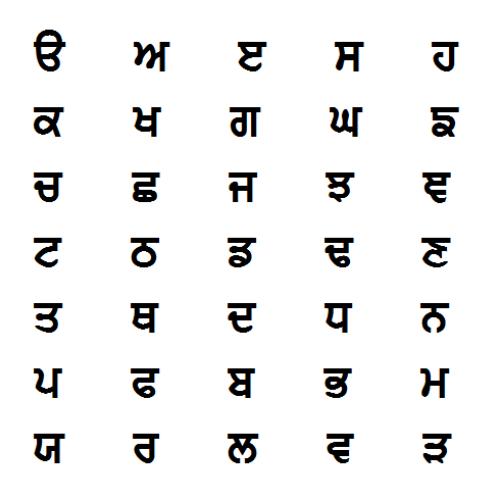
The Gurmukhi script, developed in the 16th century by Guru Angad Dev Ji, is a phonetic writing system designed to accurately represent Punjabi’s sounds. Unlike Devanagari (used in Hindi) or Shahmukhi (Perso-Arabic script for Punjabi in Pakistan), Gurmukhi features 35 basic letters: 14 vowels (svar), 33 consonants (vyanjan), and a unique system for consonant clusters (halant and virām).Letter Classification
Comparison with Devanagari and Shahmukhi
Phonetic Precision
Feature Gurmukhi Devanagari Shahmukhi Direction Left-to-right Left-to-right Right-to-left Vowel Integration Matras attached above/below consonants Matras integrated into consonant heads Separate vowel letters Consonant Clusters Halant (ਅ) + second consonant Virām (्) + second consonant Ligatures or separate letters Unique Letters ੜ, ਡ, ਢ (retroflex sounds) No equivalents No equivalents (uses Arabic letters)
Gurmukhi’s design ensures that each letter corresponds to a distinct phoneme, facilitating accurate pronunciation. For instance, the letter ਛ (chha) represents the aspirated palatal affricate /t͡ʃʰ/, a sound absent in Devanagari’s Hindi script. This precision is critical in religious texts, where mispronunciation could alter meaning.
Punjabi in Sacred Texts: Poetic Meter and Theological Terminology
Punjabi’s role in sacred literature is most prominently exemplified in the Guru Granth Sahib, the central scripture of Sikhism, composed in a blend of Punjabi, Hindi, Braj, and other languages. The text employs specific poetic meters (chaupai and sawwaiya) and theological terminology to convey spiritual truths.Poetic Meters
(Sat Naam Karatā Purakh Nirbhau Nirvair Akāl Mūrat Ajūnī Saibhan Gur Prasād Jagat Merā Dharm) This meter emphasizes rhythmic flow, aiding memorization and chanting.
- Sawwaiya (ਸਵੈਯਾ): A longer stanza (typically 16-20 lines) with a 11-11-11-11 syllable pattern, used for philosophical discourses.
Theological Terminology
The Guru Granth Sahib introduces Punjabi-specific terms for spiritual concepts:
Phonetic and Semantic Adaptations
In Sikh scriptures, Punjabi undergoes adaptations to align with theological themes:
The Guru Granth Sahib’s linguistic choices reflect its multicultural authorship, where Punjabi’s phonetic clarity and poetic meters serve as tools for universal spiritual communication.
Punjabi in Modern Media: Literature, Film, and Music
The evolution of Punjabi as a dynamic linguistic and cultural force in modern media reflects its resilience and adaptability across literary, cinematic, and musical landscapes. From the oral epics of the medieval period to the digital poetry of the 21st century, Punjabi literature has continuously reinvented itself while preserving its core themes of love, rebellion, and identity. Similarly, Punjabi cinema has transitioned from socially conscious films to globally acclaimed romantic blockbusters, while music has bridged traditional folk genres with contemporary fusion, resonating with both rural and diasporic communities. These mediums collectively underscore Punjabi’s ability to narrate cultural narratives while engaging with global trends.The interplay between tradition and innovation in Punjabi media not only preserves linguistic heritage but also redefines it for modern audiences. Literary works now blend classical metaphors with urban realism, films address migration and gender dynamics, and music merges folk rhythms with electronic beats, creating a vibrant cultural tapestry. Below, the transformation of Punjabi literature, cinema, and music is examined through key milestones, thematic categorizations, and global influences.
Evolution of Punjabi Literature: From Classical Epics to Contemporary Voices
Punjabi literature traces its origins to the Sufi and Bhakti traditions of the 16th–18th centuries, with works like Heer Ranjha (by Waris Shah) and Sassi Punnun (by Hashim Shah) becoming foundational texts. These epics, rooted in oral storytelling, explored themes of forbidden love, separation, and divine devotion, using poetic devices like dohe (couplets) and boliyan (proverbs). The 19th century saw a shift toward prose with the emergence of reformist literature, exemplified by writers like Bhai Vir Singh, who incorporated historical and mythological elements into modern narratives.The mid-20th century marked a golden age for Punjabi literature, with authors like Amrita Pritam and Puran Singh leading the charge. Pritam’s Pinjar (1950), a novel and later a play, addressed the Partition’s human cost through the lens of a woman’s tragic love story, blending lyrical prose with social critique. Her work, along with that of Nanak Singh, introduced feminist perspectives and existential questioning into Punjabi letters. The late 20th century witnessed the rise of Urban Punjabi literature, with writers like Gurdial Singh and Surjit Patar exploring alienation, industrialization, and diasporic experiences in cities like Amritsar and London.
The digital era has further democratized Punjabi literature, with platforms like Facebook, Instagram, and Wattpad hosting poets such as Jaswinder Singh ‘Jassi’ and Manmohan Waris, who use social media to reach younger audiences. Contemporary poets often employ free verse and multilingualism, mixing Punjabi with Hindi, English, and Urdu to reflect hybrid identities. For instance, Gurnam Bhullar’s work often critiques consumerism and globalization, while Amarjit Chandan’s poetry explores queer themes in Punjabi, challenging traditional norms.
"Literature is not just about words; it is the voice of a people’s soul, their joys, sorrows, and unspoken truths." — Amrita Pritam
Punjabi Cinema: Themes, Icons, and Global Influence
Punjabi cinema, often referred to as Punjabi Film Industry (PFI), emerged in the 1930s with the release of Shaheed (1935), directed by Bhai Vir Singh, which dramatized the life of Bhagat Singh. This film, produced in Gurmukhi script, became a symbol of resistance against colonialism and set the tone for socially conscious storytelling. The 1950s–1970s saw the rise of folk cinema, with films like Sohni Mahiwal (1958) and Heer Ranjha (1970) adapting classical epics into melodramatic narratives, catering to rural audiences.The 1980s and 1990s marked a turning point with the action-hero genre, led by stars like Dharmendra and Raj Kaushal, who portrayed vigilante characters in films such as Des Pardes (1978) and Ghungroo (1993). However, it was the romantic comedy that gained unprecedented popularity, with Dilwale Dulhania Le Jayenge (1995) directed by Aditya Chopra becoming a cultural phenomenon. The film’s themes of love, family honor, and cross-cultural romance resonated globally, making it one of the highest-grossing Indian films of all time. Its impact extended beyond Bollywood, influencing Punjabi cinema’s shift toward pan-Indian appeal.
Themes in Punjabi cinema can be categorized as follows:
-
Migration and Diaspora
Films like London 1419 (2010) and Jatt & Juliet (2012) explore the struggles of Punjabi migrants in the UK and Canada, addressing issues of identity, assimilation, and generational conflicts. London 1419, for instance, critiques the exploitation of Sikh laborers in the UK, while Jatt & Juliet blends romance with the challenges of arranged marriages in diaspora communities. -
Social Critique and Feminism
Pinjar (2003), based on Amrita Pritam’s novel, revisits the Partition through the lens of gender violence. Chak De! India (2007), though primarily a sports film, subtly addresses caste and class barriers in Indian society. Queen (2014), though not Punjabi-centric, features a strong Punjabi female protagonist navigating patriarchal norms. -
Romance and Family Drama
Dilwale Dulhania Le Jayenge remains the benchmark, but films like Sardar Udham (2021) and Bholaa (2022) also explore love stories within historical and contemporary contexts. Bholaa, in particular, uses humor and satire to depict modern Punjabi youth navigating relationships and societal expectations. -
Action and Vigilante Justice
The 1980s–90s saw films like Ghungroo and Dil Diya Dard Liya (1991) glorify dacoits as folk heroes, reflecting the turbulent political climate of Punjab during the insurgency. Modern films like Sardar Udham and The Legend of Bhagat Singh (2002) recontextualize these narratives within a nationalist framework.
"Punjabi cinema is not just entertainment; it is a mirror reflecting the aspirations, struggles, and dreams of a community spread across continents." — Aditya Chopra (Director, Dilwale Dulhania Le Jayenge)
Punjabi Music: From Folk to Global Fusion
Punjabi music is a mosaic of folk traditions, Sufi devotional songs, and contemporary genres, each serving as a vessel for cultural expression. Traditional forms include:The late 20th century saw the rise of Punjabi pop and rock, with artists like Jazzy B and Panjabi MC blending rap, hip-hop, and Punjabi lyrics to address diasporic identity, police brutality, and cultural alienation. Panjabi MC’s Mundian To Bach Ke Raha (1999) became an anthem for Punjabi youth in the UK, critiquing societal pressures through humorous yet poignant lyrics. Similarly, Diljit Dosanjh emerged as a pop-folk crossover artist, merging traditional melodies with modern production, themes of love, heartbreak, and materialism.
The 21st century has witnessed further globalization, with artists like AP Dhillon

Punjabi Diaspora: Language Preservation and Adaptation
The Punjabi diaspora, dispersed across Canada, the United Kingdom, Australia, and other regions, has undergone significant linguistic evolution while maintaining cultural ties to Punjab. Migration in the late 20th century led to the integration of Punjabi into multilingual environments, where communities employ strategies like code-switching, media adaptation, and neologisms to sustain linguistic identity. These adaptations reflect both the challenges of assimilation and the resilience of Punjabi as a living language in global contexts.The preservation and transformation of Punjabi in diaspora settings are influenced by socioeconomic factors, generational shifts, and digital communication. While older generations often prioritize fluency in Punjabi, younger diaspora members frequently engage with the language through hybrid forms, blending it with English, local slang, and digital vernacular. Media tailored for diaspora audiences—such as newspapers, television channels, and social media—play a critical role in reinforcing linguistic and cultural continuity. Additionally, linguistic innovations, including loanwords and altered pronunciations, demonstrate the dynamic nature of Punjabi in new sociolinguistic landscapes.
Code-Switching and Linguistic Hybridization in Diaspora Punjabi
Code-switching—the deliberate alternation between Punjabi and English (or local languages)—is a defining feature of Punjabi diaspora communication. This practice serves pragmatic functions, such as addressing monolingual speakers, but also reflects cultural negotiation. For instance, in Canadian Punjabi communities, phrases like "Chalo, let’s go out for gossip (ਗੱਸਪ) today" merge Punjabi (chalo) with English (gossip), illustrating how lexical borrowing adapts to contemporary social norms. Similarly, in the UK, terms like "I’m parking my bike" (using English parking instead of Punjabi thamakna) highlight the influence of local English dialects.Research indicates that code-switching patterns vary by context:
A 2018 study by Punjabi Language and Culture Research Centre (PLCRC) noted that 78% of Punjabi-Canadian youth reported using code-switching daily, with 62% acknowledging it as a means to "keep Punjabi relevant" while navigating bilingual identities.
Diaspora-Tailored Punjabi Media and Cultural Production
Media designed for diaspora audiences acts as a bridge between traditional Punjabi culture and modern global lifestyles. These platforms cater to linguistic and cultural needs, often blending entertainment with educational content. Key examples include:-
Print Media
Newspapers like Desi Bulletin (Canada) and Asian Voice (UK) publish in Punjabi and English, covering news, community events, and cultural commentary. Desi Bulletin, launched in 2001, includes a dedicated "Punjabi Word of the Week" column to revive lesser-used terms (e.g., "jhola" for bag, "chakki" for millstone). -
Television and Streaming
Channels such as PTC Punjabi (Canada) and BBC Punjabi (UK) broadcast dramas, music, and religious programs. PTC Punjabi’s "Diaspora Dialogues" segment features interviews with elderly migrants discussing language preservation strategies. Streaming platforms like YouTube host channels like Punjabi Music Factory, which mix traditional bhangra with modern beats, appealing to younger audiences. -
Social Media and Digital Influencers
Platforms like Instagram and TikTok host Punjabi-language content creators such as @punjabiwithlove (Canada), who use memes, slang, and transliterated English to engage diaspora youth. @desipunjabi (UK) combines Punjabi with British slang (e.g., "Yeh cheeky lagta hai!" for "This seems rude!"). These influencers often collaborate with brands to create Punjabi-English hybrid marketing slogans (e.g., "Get fit, na?!" for fitness campaigns). -
Radio and Podcasts
Stations like Radio Punjabi (Australia) and podcasts like "Bollywood & Bhangra" (UK) discuss diaspora experiences, language trends, and cultural clashes. Podcasts frequently feature "Punjabi Proverbs Explained" segments to educate listeners on idiomatic expressions (e.g., "Ghar ki muhalla, bahar ki duniya"—"Home is heaven, the world is hell").
Linguistic Innovations: Loanwords, Neologisms, and Phonetic Shifts
The Punjabi diaspora has introduced numerous linguistic innovations to adapt to technological, social, and cultural changes. These include:-
Loanwords from English and Local Languages
The integration of English vocabulary into Punjabi reflects daily interactions. Common examples:- WhatsApp karna (to WhatsApp) – Replaces "message karna" or *"call karna".
- Google karna (to Google) – Used interchangeably with *"search karna".
- Parking karna (to park) – Instead of "rakhna" (to place).
- Selfie lena (to take a selfie) – Borrowed directly from English.
- Brexit (used in UK diaspora) – Retained in its English form during political discussions.
-
Neologisms Reflecting Modern Lifestyles
New terms emerge to describe contemporary experiences:- Gossip (ਗੱਸਪ) – Used for idle chatter, replacing "bol-bal" or *"gossip karna".
- Chill karna (to relax) – Borrowed from English "chill", now a staple in youth slang.
- Crush (ਕਰਸ਼) – Used for romantic interest, replacing "pyaar" or *"muhabbat".
- Hype (ਹਾਈਪ) – Describes excitement, as in "Yeh hype lag raha hai!" (This is getting exciting!).
-
Phonetic and Pronunciation Shifts
Exposure to English and local accents leads to systematic phonetic changes in Punjabi:- Vowel shifts: The Punjabi vowel "ਅ" (as in "ਪਾਣੀ" for water) is often pronounced as "eh" (as in English "bed"), resulting in "panee" instead of *"paani".
- Consonant softening: The retroflex "ਟ" (as in "ਟੱਚ" for touch) may sound like English "ch" (e.g., "chatch" instead of "tatch").
- Stress patterns: English-style stress (e.g., "WHATS-app" instead of Punjabi’s even-toned "ਵਾਟਸਅਪ") becomes more pronounced in younger speakers.
- Rhoticity: In some UK diaspora communities, the Punjabi "ਰ" (retroflex r) is pronounced as English "r" (e.g., "roti" sounding like "row-tee").
Punjabi emerges not merely as a language but as a living testament to the resilience of cultural heritage in the face of historical upheavals and modern migrations. Its grammatical precision, dual scriptural legacy, and rich literary and musical traditions demonstrate how language can embody spiritual devotion, social commentary, and communal identity. From the classical epics of Waris Shah to the digital poetry of contemporary authors, and from the diaspora’s code-switching innovations to the global reach of bhangra and qawwali, Punjabi continues to redefine itself while honoring its past. As communities across the world navigate language preservation and adaptation, Punjabi’s story serves as an inspiration—one of continuity, creativity, and the unbreakable bond between speech and culture.
FAQ
What is Punjabi food and what makes it unique?
Punjabi food refers to the cuisine of the Punjab region, known for rich flavors, dairy products like butter and ghee, and dishes such as butter chicken, dal makhani, and sarson ka saag. It blends spices, slow-cooked meats, and hearty breads like naan and roti, reflecting both Indian and Pakistani culinary traditions.
What is the Punjabi language and where is it spoken?
The Punjabi language is an Indo-Aryan language with over 120 million speakers, primarily in Punjab (India and Pakistan), as well as diaspora communities like the UK, Canada, and Australia. It uses the Gurmukhi script (Sikhism) and Shahmukhi script (Islam), and is known for its poetic and musical traditions.
What is the current Punjabi month and date today?
The Punjabi calendar follows the Nanakshahi or Vikrami systems; today’s date depends on the regional calendar. For Nanakshahi (used by Sikhs), check a converter (e.g., Chet 15, 555). For traditional lunar calendars, dates vary by location—verify with a Punjabi calendar tool.
What is the Punjabi date today in Pakistan?
Pakistan uses the Islamic (Hijri) calendar for official purposes, but Punjabi regions often reference the Vikrami or Hijri dates. Today’s date in Pakistan’s Punjabi areas would be, for example, 15 Rajab 1446 AH (Islamic) or Bhadon 25, 2080 (Vikrami)—check local sources for exact lunar dates.
What is the Punjabi religion and how does it differ by region?
Punjab is home to diverse religions: Sikhism (dominant in Indian Punjab), Islam (majority in Pakistani Punjab), and significant Hindu and Christian communities. Sikhism centers on Guru Granth Sahib, while Pakistani Punjabis often follow Sunni Islam, with cultural practices blending Sufi traditions.
What does "Punjabi" mean?
"Punjabi" comes from the Sanskrit Pañc Nadi ("five rivers"), referring to the Indus, Jhelum, Chenab, Ravi, and Sutlej rivers that define the Punjab region. It describes both the ethnic group, language, and cultural identity of people from Punjab, India, and Pakistan.
Leave a Comment
Comments are moderated before appearing. The data you submit is processed according to the Privacy Policy of Voltefac.