What Is The Alkalinity And Its Critical Chemical Role
Table of Contents
- Scientific Definition and Chemical Basics of Alkalinity
- Chemical Definition and Role in Acid Neutralization
- Primary Contributors to Alkalinity and Their pH-Dependent Dominance
- Comparison of Alkalinity and Acidity: Chemical Formulas, pH Ranges, and Real-World Examples
- Distinguishing Alkalinity from Basicity: Edge Cases and Amphoteric Behavior
- Measurement Methods and Units of Alkalinity
- Standard Titration Methods for Alkalinity Determination
- Comparison of Alkalinity Measurement Units and Applications
- Natural and Anthropogenic Sources of Alkalinity
- Primary Natural Sources of Alkalinity
- Anthropogenic Alterations to Alkalinity Levels
- Ecological Consequences of Alkalinity Fluctuations
- Pathways of Alkalinity Cycling in Closed Systems
- Applications and Importance of Alkalinity in Diverse Fields
- Role of Alkalinity in Water Treatment Processes
- Industrial Applications and Sector-Specific Alkalinity Management
- Comparative Alkalinity Ranges for Key Domains
- FAQ
- What does alkalinity mean in the context of a swimming pool?
- What is alkalinity, and how does it relate to water quality?
- How alkaline is typical tap water, and what factors influence it?
- What should the alkalinity level be in a properly maintained pool?
- Is rainwater alkaline or acidic, and what affects its alkalinity?
- What is the typical alkalinity range for safe drinking water?
Alkalinity represents a fundamental yet often underappreciated property of water, serving as a critical buffer against acidification in both natural and engineered systems. Unlike pH, which measures hydrogen ion concentration, alkalinity quantifies the water’s capacity to neutralize acids—a dynamic equilibrium governed by dissolved ions like bicarbonate, carbonate, and hydroxide. This chemical resilience underpins ecosystems, industrial processes, and public health standards, yet its measurement and management remain pivotal in addressing challenges from pollution to water treatment inefficiencies. Understanding alkalinity is essential for scientists, engineers, and policymakers navigating the delicate balance between environmental stability and human intervention.
The concept extends beyond mere chemical definitions to encompass real-world applications, from safeguarding coral reefs against ocean acidification to optimizing disinfection in municipal water systems. By dissecting its sources—whether from limestone erosion or agricultural runoff—and exploring its measurement through titration and advanced instrumentation, this discussion bridges theoretical principles with practical implications. Whether assessing the health of a freshwater lake or ensuring compliance with drinking water regulations, alkalinity emerges as a cornerstone of sustainable resource management.
Scientific Definition and Chemical Basics of Alkalinity
Alkalinity is a fundamental water quality parameter that quantifies the capacity of an aqueous solution to resist changes in pH when exposed to acidic inputs. Chemically, it represents the total concentration of titratable bases—primarily inorganic anions such as bicarbonate (HCO₃⁻), carbonate (CO₃²⁻), and hydroxide (OH⁻)—that neutralize protons (H⁺) through buffering reactions. Unlike basicity, which refers to the presence of free hydroxide ions (OH⁻) alone, alkalinity encompasses a broader spectrum of species capable of proton acceptance, making it a critical metric in environmental, industrial, and biological systems.The measurement of alkalinity is essential for assessing water stability in natural ecosystems, wastewater treatment processes, and drinking water distribution networks. For instance, in freshwater systems, alkalinity mitigates acid rain impacts, while in seawater, it influences carbonate chemistry critical for marine life. Below, the chemical foundations of alkalinity are explored, including its ionic contributors, pH-dependent dominance, and distinctions from acidity and basicity.
Chemical Definition and Role in Acid Neutralization
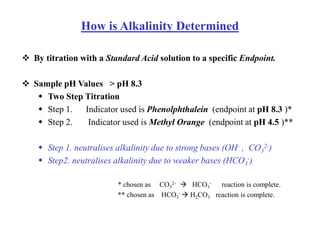
Alkalinity is defined as the equivalents per liter (eq/L) of proton (H⁺) acceptance by a solution, typically expressed in milligrams per liter (mg/L) as calcium carbonate (CaCO₃). The primary reactions governing alkalinity involve the dissociation of carbonic acid (H₂CO₃), a weak acid formed from dissolved CO₂ in water:Key Reactions:The titration endpoint for alkalinity measurement typically occurs at pH 4.5 (using sulfuric acid), where all bicarbonate and carbonate are converted to carbonic acid, while hydroxide ions are neutralized first. This endpoint ensures accurate quantification of total alkalinity (TA), which is calculated as:
1. Bicarbonate Buffering (pH 6.3–10.3):
HCO₃⁻ + H⁺ ⇌ H₂CO₃ (or CO₂ + H₂O)
This reaction dominates in most natural waters, where bicarbonate acts as the primary buffer against pH fluctuations.2. Carbonate Buffering (pH 8.3–11.0):
CO₃²⁻ + H⁺ ⇌ HCO₃⁻
Carbonate ions become significant at higher pH, contributing to stronger buffering capacity in alkaline environments like soda lakes or industrial effluents.3. Hydroxide Neutralization (pH > 11.0):
OH⁻ + H⁺ ⇌ H₂O
Hydroxide ions directly neutralize protons, but their contribution to alkalinity is minimal in most natural systems due to their low concentration at lower pH ranges.
Total Alkalinity (TA) = [HCO₃⁻] + 2[CO₃²⁻] + [OH⁻] (in eq/L)
Primary Contributors to Alkalinity and Their pH-Dependent Dominance
The relative abundance of alkalinity contributors varies with pH, dictated by the carbonate system equilibrium and the K₁/K₂ dissociation constants of carbonic acid (K₁ = 4.3 × 10⁻⁷, K₂ = 4.7 × 10⁻¹¹ at 25°C). Below is a breakdown of their roles across typical pH ranges:Dominant Species by pH Range:A comparison of these species’ contributions is provided in the table below, alongside their chemical formulas and typical sources.
pH < 6.3: Minimal alkalinity; H₂CO₃/CO₂ predominates, with negligible HCO₃⁻ or CO₃²⁻. pH 6.3–8.3: Bicarbonate (HCO₃⁻) is the primary contributor, accounting for >90% of alkalinity in most freshwater and seawater. pH 8.3–10.3: Carbonate (CO₃²⁻) becomes significant, especially in alkaline lakes or industrial discharges. pH > 11.0: Hydroxide (OH⁻) dominates, though such conditions are rare in natural waters except in strongly basic environments (e.g., caustic soda spills).
Comparison of Alkalinity and Acidity: Chemical Formulas, pH Ranges, and Real-World Examples
While alkalinity reflects proton acceptance, acidity measures proton donation, primarily from strong acids (e.g., HCl, H₂SO₄) or weak acids like carbonic acid. The table contrasts their key ionic species, dominance pH ranges, and environmental contexts:| Parameter | Key Ionic Species | Chemical Formula | Dominant pH Range | Real-World Example |
|---|---|---|---|---|
| Alkalinity | Bicarbonate | HCO₃⁻ | 6.3–10.3 | Most natural waters (rivers, lakes), seawater (avg. 2.3 meq/L) |
| Carbonate | CO₃²⁻ | 8.3–11.0 | Soda lakes (e.g., Mono Lake, pH 9.8–10.5), alkaline industrial effluents | |
| Hydroxide | OH⁻ | >11.0 | Caustic soda solutions, strongly basic wastewater | |
| Acidity | Hydrogen Ion | H⁺ | <6.0 | Acid mine drainage (pH 2–4), strong acid spills (e.g., sulfuric acid) |
| Carbonic Acid | H₂CO₃ (or CO₂ + H₂O) | 4.5–6.3 | Distilled water exposed to air (pH ~5.6–5.8), soft water | |
| Bisulfate | HSO₄⁻ | 1.0–4.0 | Sulfuric acid-contaminated groundwater, battery acid |
Distinguishing Alkalinity from Basicity: Edge Cases and Amphoteric Behavior
Alkalinity and basicity are often conflated, but they differ fundamentally in scope and measurement:Key Differences:Edge Cases:
Alkalinity: A titratable measure of proton acceptance by all bases (HCO₃⁻, CO₃²⁻, OH⁻) in a sample, regardless of their origin. It is quantified via titration to a fixed endpoint (pH 4.5). Basicity: Refers specifically to the free hydroxide ion concentration ([OH⁻]), which is a subset of alkalinity. Basicity is pH-dependent and does not account for bicarbonate or carbonate contributions.
1. Amphoteric Substances:
Compounds like aluminum hydroxide (Al(OH)₃) or silicates (SiO₃²⁻) can contribute to alkalinity in specific conditions. For
Measurement Methods and Units of Alkalinity
Alkalinity measurement is a critical analytical procedure in environmental, industrial, and municipal water quality assessments, ensuring compliance with regulatory standards and optimizing treatment processes. Standardized titration methods remain the gold standard for accuracy, while field-based techniques offer rapid, on-site evaluations with trade-offs in precision. This section details the procedural protocols for laboratory titration, the mathematical derivation of alkalinity from titration data, and a comparative analysis of measurement units, methods, and their industrial applications.Standard Titration Methods for Alkalinity Determination
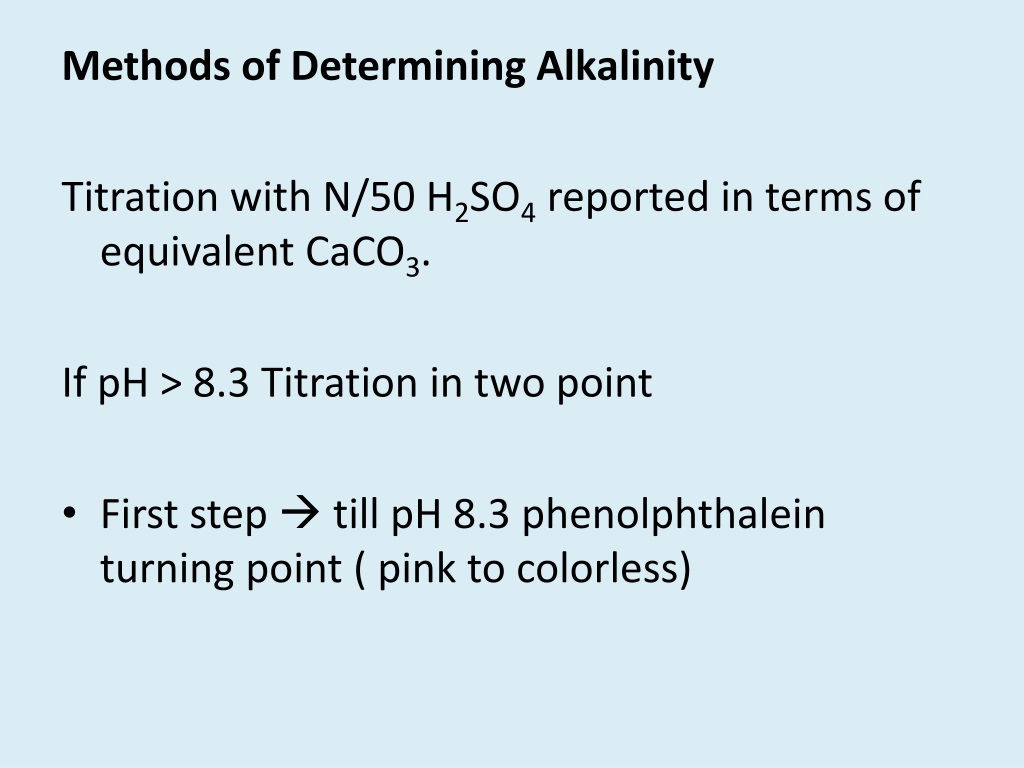
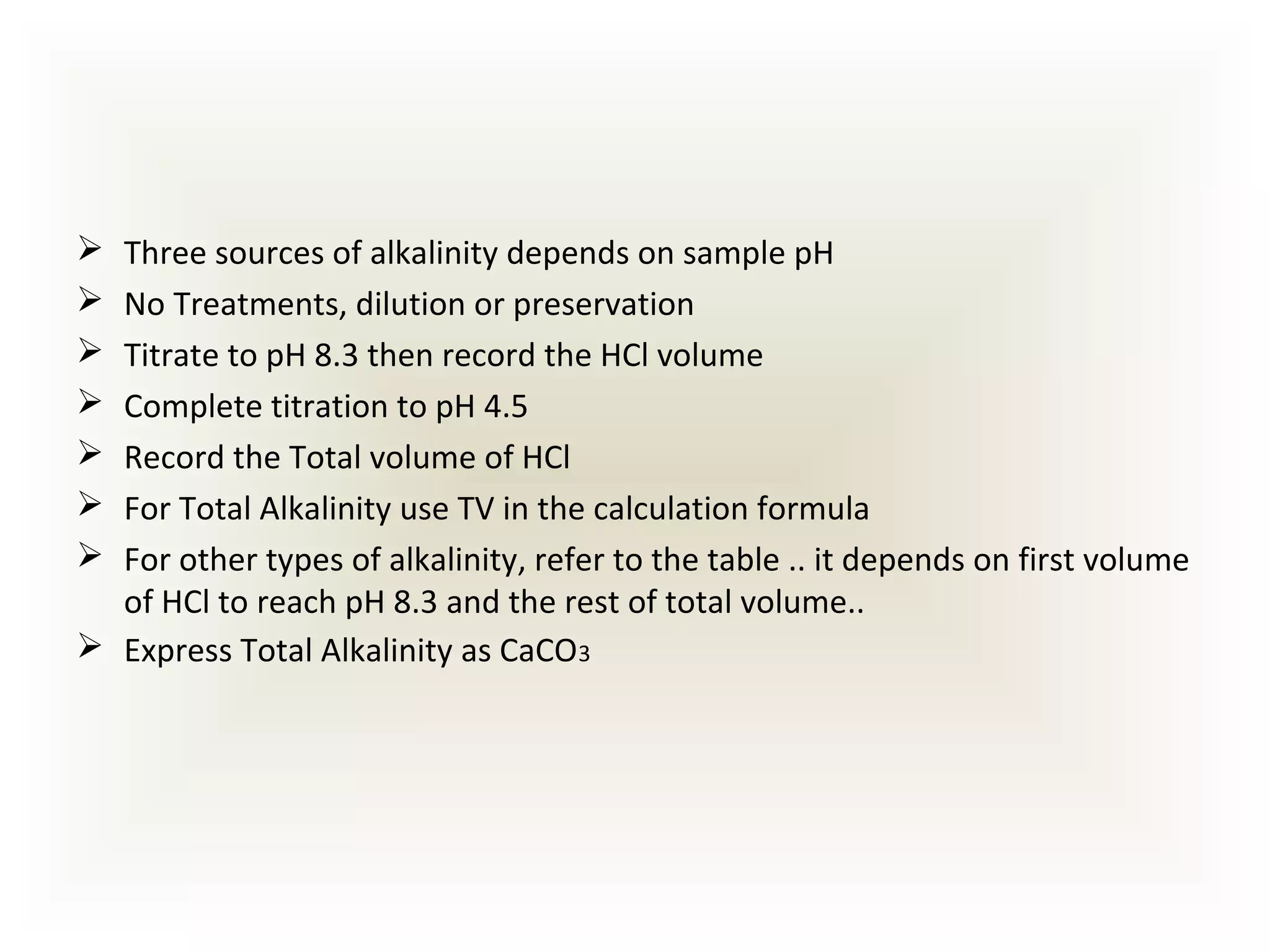
Titration-based alkalinity analysis relies on the neutralization of alkaline species (e.g., hydroxide, carbonate, bicarbonate) using a standardized acid titrant, typically 0.02 N sulfuric acid (H₂SO₄) or 0.1 N hydrochloric acid (HCl). The choice of indicator dictates the detection of specific alkalinity fractions: phenolphthalein (pH 8.3–10.0) targets hydroxide (OH⁻) and half of carbonate (CO₃²⁻), while methyl orange (pH 3.1–4.4) captures total alkalinity by neutralizing all forms, including bicarbonate (HCO₃⁻). The U.S. Environmental Protection Agency (EPA) Method 310.1 and Standard Methods for the Examination of Water and Wastewater (23rd ed.) outline these procedures for wastewater, drinking water, and natural water bodies.Step-by-Step Laboratory Procedure for Titration
1. Sample Preparation
2. Indicator Addition
3. Titration to Endpoint
4. Calculations
\[
\text{P-Alk (mg/L as CaCO₃)} = \frac{(V_1 \times N \times 50,000)}{\text{Sample Volume (mL)}}
\]
Total Alkalinity (M-Alk):
\[
\text{M-Alk (mg/L as CaCO₃)} = \frac{(V_2 \times N \times 50,000)}{\text{Sample Volume (mL)}}
\]
Carbonate Alkalinity (C-Alk):
\[
\text{C-Alk (mg/L as CaCO₃)} = 2 \times \text{P-Alk}
\]
Bicarbonate Alkalinity (H-Alk):
\[
\text{H-Alk (mg/L as CaCO₃)} = \text{M-Alk} - \text{P-Alk}
\] Note: The factor 50,000 converts meq/L to mg/L as CaCO₃ (molecular weight of CaCO₃ = 100 g/mol; equivalence factor = 2 meq/g).
5. Example Calculation
A 75 mL sample is titrated with 0.02 N H₂SO₄:
\[
\text{P-Alk} = \frac{(8.5 \times 0.02 \times 50,000)}{75} = 113.3 \text{ mg/L as CaCO₃}
\]
\[
\text{M-Alk} = \frac{(22.0 \times 0.02 \times 50,000)}{75} = 373.3 \text{ mg/L as CaCO₃}
\]
\[
\text{C-Alk} = 2 \times 113.3 = 226.6 \text{ mg/L as CaCO₃}
\]
\[
\text{H-Alk} = 373.3 - 113.3 = 260.0 \text{ mg/L as CaCO₃}
\]
Comparison of Alkalinity Measurement Units and Applications
Alkalinity is quantified in multiple units, each suited to specific industries or analytical contexts. The following table summarizes common units, their conversions, and typical applications, derived from standard references such as the World Health Organization (WHO) Guidelines for Drinking-Water Quality and ASTM International (D1067).| Unit | Conversion to mg/L as CaCO₃ | Typical Applications | Limitations | ||||||||||||||||||||
|---|---|---|---|---|---|---|---|---|---|---|---|---|---|---|---|---|---|---|---|---|---|---|---|
| meq/L (milliequivalents per liter) | 1 meq/L = 50 mg/L as CaCO₃ |
|
|
||||||||||||||||||||
| ppm (parts per million) | 1 ppm ≈ 1 mg/L as CaCO₃ (for dilute aqueous solutions) |
|
|
||||||||||||||||||||
| µS/cm (microsiemens per centimeter) | Indirect; conductivity correlates with ionic strength, not alkalinity directly. |
|
|
||||||||||||||||||||
| mol/m³ (moles per cubic meter) | 1 mol/m³ = 50,000 mg/L as CaCO₃ |
|
|
Leave a Comment
Comments are moderated before appearing. The data you submit is processed according to the Privacy Policy of Voltefac.