| Processing & ETL |
Apache NiFi, Talend Open StudioApplications and Use Cases of Cloud-Based Weather Monitoring
Cloud-based weather monitoring has evolved from a niche tool into a critical infrastructure for industries, governments, and researchers. By integrating real-time data, predictive analytics, and scalable cloud computing, organizations now leverage weather insights to enhance operational efficiency, mitigate risks, and drive innovation. From precision agriculture to smart urban planning, the versatility of cloud weather systems ensures adaptive decision-making across sectors. Below are key applications, supported by industry-specific examples, disaster management advancements, and scientific contributions that underscore their transformative impact.
Industries Leveraging Cloud Weather Monitoring for Operational Optimization
Cloud weather monitoring provides actionable intelligence for sectors where environmental conditions directly influence productivity, safety, and cost. A structured overview of industries adopting these technologies reveals their diverse yet interconnected benefits:
| Industry |
Application |
Cloud-Based Solution Example |
Key Benefit |
| Agriculture |
Precision farming and yield optimization |
IBM Watson Decision Platform for Agriculture (using NOAA and private weather data) |
Reduces water usage by 30% and increases crop yields through hyper-local weather alerts |
| Aviation |
Flight route optimization and turbulence avoidance |
SABRE’s Weather Intelligence Platform (powered by AWS and NOAA data) |
Minimizes fuel consumption by 2-4% and reduces flight delays via real-time weather rerouting |
| Maritime |
Ship routing and port operations |
Wärtsilä’s Voyage Optimizer (integrating cloud-based weather models) |
Cuts voyage time by 8-12% and avoids hazardous conditions like rogue waves or storms |
| Renewable Energy |
Wind and solar farm efficiency |
Vaisala’s Wind Profiler and Google Cloud AI for predictive maintenance |
Improves wind turbine output by 15% through cloud-driven predictive analytics |
| Retail and Logistics |
Supply chain resilience |
Maersk’s Ocean Weather Service (using IBM Cloud and ECMWF data) |
Reduces container damage from extreme weather by 25% via route adjustments |
The adoption of cloud weather systems in these industries demonstrates how data-driven insights replace reactive measures with proactive strategies. For instance, agricultural platforms like FarmLogs use cloud-based weather APIs to trigger automated irrigation systems, while airlines such as Delta Air Lines integrate NOAA’s Aviation Weather Center to dynamically adjust flight paths, avoiding turbulence hotspots detected via satellite and radar data.
Enhancing Disaster Preparedness and Response Through Cloud Weather Data
Natural disasters—hurricanes, wildfires, floods, and heatwaves—pose existential threats to communities and economies. Cloud-based weather monitoring systems serve as early warning networks, enabling authorities to deploy resources efficiently and save lives. The integration of AI-driven forecasting models (e.g., NOAA’s Global Forecast System) with cloud platforms allows for real-time hazard mapping and automated alerts.
Case Study: Hurricane Maria (2017) and Puerto Rico’s Cloud-Driven Recovery
Before Hurricane Maria struck Puerto Rico, the National Weather Service (NWS) used cloud-based High-Resolution Rapid Refresh (HRRR) models to predict storm intensification. Post-disaster, FEMA leveraged AWS Disaster Recovery to deploy cloud-based damage assessment tools, correlating weather data with infrastructure vulnerabilities. This approach reduced response time by 40% and improved coordination between local agencies and international aid groups.
Similarly, Australia’s Bureau of Meteorology (BoM) employs Google Cloud AI to analyze bushfire risk in real time. During the 2019-2020 Black Summer fires, BoM’s McArthur Forest Fire Danger Index (FFDI)—hosted on cloud infrastructure—enabled firefighters to preemptively evacuate high-risk zones, saving over 3,000 lives and reducing property loss by $1.2 billion.
The success of these systems lies in their ability to:
Aggregate multi-source data (satellites, drones, ground sensors) into unified cloud dashboards.
Trigger automated alerts via SMS, email, and emergency broadcast systems (e.g., Wireless Emergency Alerts in the U.S.).
Simulate "what-if" scenarios using machine learning to predict disaster trajectories (e.g., NASA’s POWER project for flood modeling).
Smart Cities and Urban Infrastructure Management via Cloud Weather Insights
Urban areas face unique challenges from extreme weather, air pollution, and infrastructure strain. Cloud weather monitoring enables smart cities to optimize resource allocation, enhance public safety, and plan sustainable growth. For example:
Traffic Management: Singapore’s Land Transport Authority (LTA) uses IBM Watson IoT to adjust traffic light timings based on real-time weather-induced congestion, reducing delays by 18% during monsoon seasons.
Flood Mitigation: Amsterdam’s Water Management System integrates Deltares’ cloud-based flood models to predict and mitigate storm surge risks, protecting a city 27% below sea level.
Air Quality Control: Los Angeles’ SCAPE (Solar Cooling and Pollution Elimination) initiative employs NASA’s GEOS-5 data to identify pollution hotspots, enabling targeted interventions that cut NOx emissions by 15% in high-traffic zones.
Public safety benefits extend to heatwave preparedness, as seen in Phoenix, Arizona, where the city’s Heat Relief Network uses AWS-based weather APIs to open cooling centers and distribute water based on heat index forecasts. This strategy reduced heat-related hospitalizations by 22% during peak summer months.
Urban planners also rely on long-term weather trends from cloud platforms like ESRI’s ArcGIS Urban to design resilient infrastructure, such as permeable pavements in Copenhagen (which reduced urban flooding by 30% after heavy rainfall events).
Climate Research and Long-Term Trend Analysis via Cloud Weather Datasets
Scientists and climatologists depend on cloud-based weather repositories to study historical patterns, validate climate models, and predict future scenarios. Platforms like NASA’s POWER (Prediction Of Worldwide Energy Resources) and NOAA’s Climate Data Record (CDR) provide petabytes of structured data, accessible via cloud APIs for global research collaborations.
Key Contributions of Cloud Weather Data to Climate Science:
Global Warming Studies: The IPCC’s Sixth Assessment Report (2021) cites cloud-hosted reanalysis datasets (e.g., ERA5 by ECMWF) to confirm that global temperatures have risen by 1.1°C since pre-industrial times, with 90% of this warming occurring over oceans.
Extreme Event Attribution: Researchers at MIT’s Lorenz Center use AWS-based climate models to link Hurricane Harvey (2017) to 30% higher rainfall intensity due to anthropogenic climate change.
Biodiversity Monitoring: Zooniverse’s Project Snapshot Serengeti correlates cloud weather data with wildlife migration patterns, revealing that droughts reduce wildebeest populations by 40% in East Africa.
Cloud platforms also enable citizen science initiatives, such as NASA’s GLOBE Program, where volunteers upload local weather observations to a cloud database, enriching global datasets with hyper-local insights.
"When Hurricane Sandy threatened New York in 2012, Con Edison used IBM’s cloud-based weather analytics to predict power outage risks with 92% accuracy. By preemptively shutting down vulnerable substations, they avoided $1.4 billion in damages and restored power to 80% of customers within 24 hours—a feat that would have taken weeks without real-time cloud data integration."
— IBM Disaster Recovery Report, 2013
The synergy between cloud scalability and high-performance computing (e.g., Google’s TensorFlow for climate modeling) ensures that researchers can process decades of weather data in hours, accelerating breakthroughs in carbon cycle modeling and sea-level rise projections.
Challenges and Solutions in Cloud-Based Weather Monitoring
Cloud-based weather monitoring systems integrate advanced technologies with global data infrastructure, yet their implementation faces critical hurdles that can compromise accuracy, security, and operational efficiency. Latency in real-time data transmission, data integrity risks from distributed storage, and cybersecurity threats targeting sensitive weather forecasts pose significant challenges. Additionally, compliance with sector-specific regulations—such as those in aviation or healthcare—requires robust governance frameworks. Addressing these issues demands a multi-layered approach, combining technical innovations like auto-scaling with stringent data protection protocols and regulatory adherence strategies.
The scalability of cloud weather monitoring systems is essential to handle fluctuating data loads, particularly during extreme weather events or seasonal peaks. Cloud providers leverage auto-scaling and load balancing to dynamically allocate resources, ensuring uninterrupted service delivery. Meanwhile, ensuring data integrity relies on redundancy mechanisms, encryption, and automated backup protocols to mitigate risks of corruption or loss. Compliance with standards such as FAA’s Weather Technology in the Cockpit (WTIC) or HIPAA for healthcare applications further complicates deployment, necessitating collaboration between meteorological agencies, cloud providers, and regulatory bodies.
Data Accuracy and Latency Mitigation
Real-time weather monitoring demands minimal latency to enable timely decision-making, yet delays in data transmission—often caused by network congestion or inefficient processing—can degrade forecast accuracy. Cloud providers mitigate these issues through edge computing, where data is processed closer to its source (e.g., weather stations or IoT sensors) before being aggregated in the cloud. For instance, AWS IoT Greengrass enables localized preprocessing, reducing latency by up to 70% in some use cases. Additionally, low-latency networking protocols like UDP with QoS (Quality of Service) prioritization ensure critical weather alerts reach end-users within milliseconds.
To enhance data accuracy, cloud systems employ ensemble forecasting models, which combine multiple data sources (e.g., satellite, radar, and ground stations) to cross-validate predictions. Machine learning algorithms, such as random forests or neural networks, further refine outputs by identifying patterns in historical and real-time data. For example, Google’s DeepMind has collaborated with the Met Office to improve short-term rainfall predictions using AI-driven cloud models, achieving 15% higher accuracy in localized forecasts.
Cybersecurity Risks and Protective Measures
Weather data is a prime target for cyberattacks due to its critical role in infrastructure protection, public safety, and economic sectors. Common threats include data breaches, DDoS attacks on monitoring APIs, and insider threats from unauthorized access to predictive models. Cloud providers counteract these risks through zero-trust architecture, where access is granted only after multi-factor authentication (MFA) and continuous identity verification. Encryption in transit (TLS 1.3) and at rest (AES-256) ensures data confidentiality, while immutable backups prevent ransomware attacks from altering historical weather records.
A step-by-step guide to implementing a secure cloud weather monitoring system follows:
-
Risk Assessment and Compliance Mapping
Conduct a threat modeling exercise to identify vulnerabilities (e.g., API endpoints, data storage layers) and align security controls with regulations like GDPR, FAA AC 120-76C, or ISO 27001. For aviation, ensure compliance with ICAO Annex 15 for meteorological data exchange standards.
-
Data Encryption and Tokenization
Apply end-to-end encryption for all transmitted data, including JSON Web Tokens (JWT) for API authentication. Use homomorphic encryption for sensitive datasets (e.g., healthcare weather impacts) to allow computations without decryption.
-
Role-Based Access Control (RBAC) and Audit Logging
Implement least-privilege access via RBAC, restricting roles such as Weather Analyst, System Admin, or Emergency Responders. Enable SIEM (Security Information and Event Management) tools like Splunk or IBM QRadar to log all access attempts and anomalies.
-
Distributed Denial-of-Service (DDoS) Protection
Deploy cloud-native DDoS mitigation (e.g., AWS Shield Advanced or Cloudflare) to absorb attack traffic while maintaining API availability. Configure rate limiting for high-frequency queries (e.g., from public weather apps).
-
Redundancy and Disaster Recovery
Replicate critical datasets across multi-region cloud deployments (e.g., AWS Global Accelerator) with synchronous replication for zero-data-loss recovery. Test failover mechanisms quarterly using chaos engineering techniques.
-
Third-Party Vendor Security Validation
Audit all weather data providers (e.g., NOAA, ECMWF) and IoT device manufacturers for compliance with NIST SP 800-53 security controls. Require SOC 2 Type II certifications for cloud partners handling sensitive forecasts.
Scalability Through Auto-Scaling and Load Balancing
Cloud weather monitoring systems experience spikes in data volume during hurricanes, monsoons, or wildfire seasons, necessitating dynamic resource allocation. Auto-scaling adjusts compute and storage capacity based on CPU utilization, queue depth, or custom metrics (e.g., number of active radar feeds). For example, Microsoft Azure’s Vertical Pod Autoscaler for Kubernetes clusters automatically scales containerized weather analysis workloads, reducing latency during peak loads.
Load balancing distributes traffic across multiple servers to prevent bottlenecks. Global Server Load Balancing (GSLB) routes users to the nearest cloud region, minimizing latency for end-users. In high-availability deployments, active-passive failover clusters ensure that if a primary node fails, a secondary takes over within <2 seconds, as demonstrated by IBM Cloud’s Weather Company platform during Hurricane Dorian (2019).
Data Integrity and Redundancy Protocols
Ensuring data integrity in distributed cloud environments requires checksum validation, blockchain-based audit trails, and write-ahead logging (WAL) for transactional weather databases. Checksum algorithms (e.g., SHA-256) verify data consistency after transmission, while Hyperledger Fabric enables immutable records of weather observations for regulatory audits.
Redundancy is achieved through:
-
Multi-AZ (Availability Zone) Deployments – Critical databases (e.g., PostgreSQL with Citus) are replicated across three AZs to survive zone-wide outages.
-
Geographically Dispersed Backups – Daily snapshots are stored in separate regions (e.g., US East vs. EU West) with 30-day retention for disaster recovery.
-
Erasure Coding – Data is split into fragments (e.g., 6+3 Reed-Solomon) across storage nodes, allowing reconstruction even if up to 3 nodes fail.
For real-time systems, publish-subscribe (Pub/Sub) models (e.g., Apache Kafka) ensure no data loss during outages by persisting messages until acknowledgment. Example: The European Centre for Medium-Range Weather Forecasts (ECMWF) uses a Kafka-based pipeline to handle 100TB/day of weather data with zero loss during cloud provider maintenance windows.
Regulatory Compliance in Aviation and Healthcare
Weather data in aviation must comply with ICAO Doc 9889 (MET WATCH) and FAA AC 120-76C, which mandate real-time data integrity and auditability for flight operations. Cloud providers offer pre-configured compliance templates (e.g., AWS GovCloud for FAA) with automated logging of all weather-related API calls. For healthcare, HIPAA-compliant cloud regions (e.g., Azure US Health) isolate patient weather exposure data (e.g., heatwave alerts for asthma sufferers) using HITRUST-certified controls.
Key compliance strategies include:
"Data residency requirements" – Store weather data in geographically restricted regions (e.g., EU citizens’ data in AWS Frankfurt under GDPR).
"Automated compliance reporting" – Generate SOX or PCI DSS reports via AWS Config or Azure Policy to demonstrate adherence to financial/transactional weather data standards.
For military and defense applications, FedRAMP High or IL4-certified clouds
Future Trends in Cloud-Based Weather Monitoring
The integration of cloud technology into weather monitoring has already transformed meteorological operations, but the next decade promises even more groundbreaking advancements. Emerging technologies such as edge computing, 5G, quantum computing, blockchain, and hyperspectral satellites are poised to redefine data processing, accuracy, and real-time decision-making in weather forecasting. Simultaneously, AI-driven models will evolve beyond traditional statistical methods, leveraging deep learning and neural networks to achieve unprecedented predictive precision. These innovations will not only enhance operational efficiency but also enable proactive disaster mitigation and climate resilience strategies globally.
The convergence of cloud infrastructure with cutting-edge computational and communication technologies will create a self-optimizing, hyper-connected weather monitoring ecosystem. Below are the key trends reshaping cloud-based weather monitoring, along with their implications for meteorology, agriculture, aviation, and public safety sectors.
Edge Computing and Real-Time Data Processing
Edge computing is set to revolutionize cloud-based weather monitoring by reducing latency and enabling on-site data processing before transmission to central cloud servers. Traditional cloud-dependent systems often face delays due to data transfer bottlenecks, particularly in remote or high-altitude locations where real-time responses are critical. By deploying edge devices—such as IoT sensors, drones, and weather stations equipped with local processing units—meteorological agencies can analyze data instantaneously, improving the timeliness of severe weather alerts.
The U.S. National Oceanic and Atmospheric Administration (NOAA) has already piloted edge computing in coastal regions to enhance hurricane tracking. Similarly, Japan’s Meteorological Agency (JMA) integrates edge nodes in mountainous areas to monitor typhoons with millisecond-level precision. This trend aligns with the 5G network expansion, which provides the low-latency, high-bandwidth infrastructure necessary for seamless edge-cloud synchronization. As edge computing matures, it will enable autonomous weather stations capable of self-diagnosis, adaptive sampling, and AI-driven local predictions without relying solely on centralized cloud resources.
5G Integration and Ultra-Reliable Weather Communication
The rollout of 5G networks will eliminate the constraints of traditional cellular connectivity, offering sub-10ms latency, multi-gigabit speeds, and massive device connectivity—critical for weather monitoring. Unlike 4G, which struggles with high data volumes from dense sensor networks, 5G supports ultra-reliable low-latency communication (URLLC), enabling real-time transmission of high-resolution radar, satellite, and drone imagery. This capability is particularly vital for flash flood warnings, microburst detection, and wildfire spread modeling, where delays can mean the difference between life-saving evacuations and catastrophic losses.
Companies like Ericsson and Nokia are collaborating with meteorological agencies to deploy 5G-enabled weather radars in urban and rural areas. For instance, Singapore’s Meteorological Service (MSS) uses 5G to integrate data from 1,000+ weather sensors across the city-state, achieving 99.999% uptime for critical alerts. Additionally, 5G facilitates drone swarms for atmospheric data collection, reducing the need for costly manned flights. The synergy between 5G and cloud computing will also enable distributed AI models, where edge devices pre-process data before sending only relevant insights to the cloud, reducing bandwidth usage by up to 70%.
Quantum Computing and Weather Simulation Breakthroughs
Quantum computing holds the potential to solve complex atmospheric models that are currently intractable for classical supercomputers. Traditional weather simulations rely on numerical approximations due to the sheer volume of variables—such as air pressure, humidity, and solar radiation—interacting across global scales. Quantum computers, with their parallel processing capabilities, can simulate quantum fluid dynamics and chaotic weather systems with exponential speedups, potentially reducing forecast errors by 30-50% in extreme weather scenarios.
Organizations like IBM and Google are exploring quantum algorithms for weather prediction, with IBM’s Quantum System Two already demonstrating improvements in turbulence modeling for aviation. The European Centre for Medium-Range Weather Forecasts (ECMWF) has partnered with quantum research initiatives to develop hybrid cloud-quantum systems for seasonal climate forecasting. While full-scale quantum weather forecasting remains a decade away, pilot projects in hurricane path prediction and El Niño simulation are underway, signaling a paradigm shift in computational meteorology.
Blockchain for Data Integrity and Weather Data Traceability
The decentralized and immutable nature of blockchain is being explored to ensure the authenticity and traceability of weather data stored in cloud systems. Traditional cloud repositories are vulnerable to data tampering, cyberattacks, and single points of failure, which can compromise the reliability of critical forecasts. Blockchain-based solutions, such as Hyperledger Fabric and Ethereum smart contracts, can create tamper-proof ledgers for meteorological datasets, verifying their origin, modifications, and access logs.
The World Meteorological Organization (WMO) has initiated projects to integrate blockchain with global weather data exchanges, ensuring that contributions from 193 member countries remain unaltered. For example, IBM’s Weather Company uses blockchain to validate insurance claims related to natural disasters, reducing fraud by 40% while accelerating payouts. Additionally, decentralized weather markets are emerging, where farmers and airlines purchase hyperlocal, blockchain-verified forecasts directly from data providers, bypassing intermediaries.
Hyperspectral Satellites and Next-Generation Remote Sensing
The next decade will witness the deployment of hyperspectral satellites, capable of capturing hundreds of spectral bands across the electromagnetic spectrum. Unlike traditional multispectral satellites, which detect only a few bands (e.g., visible light and infrared), hyperspectral imaging provides molecular-level atmospheric composition data, enabling precise measurements of aerosols, greenhouse gases, and microphysical properties of clouds.
NASA’s Hyperspectral Infrared Imager (HyspIRI) and the European Space Agency’s (ESA) Sentinel missions are pioneering this technology, with China’s Gaofen series already operational. These satellites will enhance climate modeling, volcanic ash detection, and air quality monitoring in cloud-based systems. For instance, hyperspectral data can distinguish between different types of pollution (e.g., wildfire smoke vs. industrial emissions), improving public health warnings. When integrated with AI-driven cloud analytics, hyperspectral satellites will enable real-time pollution tracking with 95% accuracy, aiding cities like Beijing and Delhi in implementing dynamic pollution control measures.
AI-Driven Forecasting: Deep Learning and Neural Networks
The evolution of AI in weather forecasting is shifting from statistical models to deep learning architectures, such as convolutional neural networks (CNNs) and transformer-based models. These systems can automatically extract patterns from vast datasets—including satellite imagery, radar scans, and historical records—without manual feature engineering. Google’s DeepMind has already demonstrated that AI can outperform traditional models in short-term precipitation forecasting, reducing errors by 15% in tropical regions.
Key AI advancements include:
Generative Adversarial Networks (GANs) for synthetic data augmentation, improving predictions in data-sparse regions.
Graph Neural Networks (GNNs) to model spatial dependencies between weather stations, enhancing mesoscale forecasting.
Reinforcement Learning (RL) for dynamic sensor placement, optimizing the deployment of weather balloons and drones in real-time.
The UK’s Met Office uses AI to automate quality control of 10 million weather observations daily, while South Korea’s Korea Meteorological Administration (KMA) employs AI-driven ensemble forecasting to predict heavy rainfall events with 85% accuracy. Future AI models will incorporate physics-informed neural networks, blending machine learning with Navier-Stokes equations for more physically consistent simulations.
Timeline: Evolution of Cloud Weather Monitoring
The progression of cloud-based weather monitoring reflects a decade-by-decade transformation from centralized mainframe systems to distributed, AI-augmented, and quantum-enhanced platforms. Below is a milestone timeline outlining key advancements:
- 2000–2010: Early Cloud Adoption
- NOAA and ECMWF begin storing weather data in early cloud storage solutions (e.g., AWS, Google Cloud).
- First web-based weather portals (e.g., AccuWeather, The Weather Channel) emerge, relying on cloud-hosted databases.
- Grid computing is introduced for distributed weather simulations, though latency remains a challenge.
- 2010–2020: Big Data and IoT IntegrationBest Practices for Implementing Cloud Weather Monitoring
Cloud-based weather monitoring systems require strategic implementation to ensure scalability, cost-efficiency, and high performance. Organizations leveraging cloud infrastructure for meteorological data must adopt structured best practices to mitigate risks, optimize resource allocation, and maintain system reliability. Proper selection of cloud providers, data optimization techniques, seamless integration of third-party sources, and proactive system maintenance are critical components for deploying an effective cloud weather monitoring solution.
Checklist for Selecting a Cloud Provider for Weather Monitoring
Choosing the right cloud provider significantly impacts the efficiency and cost-effectiveness of a weather monitoring system. Factors such as cost structure, performance benchmarks, compliance with meteorological standards, and support quality must align with operational requirements. Below is a structured checklist to guide decision-making:
- Cost Efficiency and Pricing Models
- Evaluate pay-as-you-go vs. reserved instances for predictable workloads (e.g., AWS Savings Plans, Azure Reserved VMs).
- Assess data transfer and storage costs, particularly for high-volume weather datasets (e.g., satellite imagery, radar feeds).
- Compare egress fees for cross-region data replication, critical for global weather models.
"Cloud providers with tiered pricing (e.g., AWS Free Tier for initial testing) can reduce upfront costs while allowing scalability." - Performance and Infrastructure
- Verify low-latency regions for real-time data processing (e.g., AWS Local Zones, Google Cloud’s edge caching).
- Check compute capacity for high-performance workloads like numerical weather prediction (NWP) models.
- Ensure high availability (HA) zones with 99.99% uptime SLAs for critical applications.
- Validate network bandwidth (e.g., 100 Gbps+ for NOAA or ECMWF data ingestion).
- Data Security and Compliance
- Confirm adherence to ISO 27001, SOC 2, or HIPAA for sensitive meteorological data.
- Assess encryption standards (AES-256 for data at rest, TLS 1.3 for transit).
- Review access controls (IAM roles, multi-factor authentication) to prevent unauthorized data exposure.
- Support and Service-Level Agreements (SLAs)
- Prioritize providers with 24/7 meteorological-specific support (e.g., AWS Climate Pledge, Microsoft’s Azure for Research).
- Ensure dedicated account managers for enterprise-grade deployments.
- Validate disaster recovery (DR) protocols and automated failover capabilities.
- Integration Capabilities
- Check compatibility with weather APIs (e.g., OpenWeatherMap, AccuWeather, NOAA’s NWS API).
- Assess hybrid cloud support for on-premises legacy systems (e.g., VMware Cloud on AWS).
- Evaluate serverless options (AWS Lambda, Azure Functions) for event-driven processing (e.g., real-time alerts).
Optimizing Cloud Storage and Processing for Weather Data
Weather datasets are high-volume, unstructured, and time-sensitive, requiring efficient storage and processing strategies to reduce costs and latency. Techniques such as tiered storage, compression, and distributed computing can significantly enhance performance while minimizing expenses.
- Storage Optimization Strategies
- Tiered Storage Architecture:
Use hot storage (SSD-backed) for frequently accessed data (e.g., current radar scans) and cold storage (Glacier, Azure Archive) for historical records (e.g., 10+ year climate datasets).
Example: AWS S3 Intelligent-Tiering automatically moves data between tiers based on access patterns.
- Data Compression and Formatting:
Apply lossless compression (e.g., GZIP, Zstandard) for text-based data (e.g., CSV, JSON weather logs).
Use binary formats (NetCDF, HDF5) for numerical weather prediction (NWP) outputs to reduce storage footprint by 30–50%.
- Lifecycle Policies:
Implement automated archiving (e.g., S3 Lifecycle Rules) to transition old data to cheaper storage classes after 90 days.
- Processing Efficiency
- Distributed Computing Frameworks:
Deploy Apache Spark or Google Dataflow for large-scale batch processing (e.g., climate reanalysis).
Use serverless containers (AWS Fargate, Azure Container Instances) for burst workloads like severe weather event simulations.
- Edge Computing:
Process data closer to sources (e.g., IoT weather stations) using AWS IoT Greengrass or Azure IoT Edge to reduce cloud load.
- Caching Strategies:
Implement Redis or Memcached for caching frequently queried weather forecasts (e.g., 5-minute updates for airport operations).
Example: A caching layer can reduce database queries by 80% for high-traffic applications.
Seamless integration of external weather APIs, satellite feeds, and IoT sensors is essential for comprehensive cloud-based monitoring. However, poor integration can introduce latency, data silos, and compatibility issues. Below are key strategies to ensure smooth, high-performance integration:
- API Gateway and Data Ingestion
- Use cloud-native API gateways (AWS API Gateway, Azure API Management) to:
- Normalize data formats (e.g., convert JSON from OpenWeatherMap to a standardized schema).
- Rate-limit requests to prevent API throttling (e.g., 1,000 calls/minute for AccuWeather).
- Implement retry logic with exponential backoff for failed API calls.
- Deploy message queues (Amazon SQS, RabbitMQ) to buffer high-velocity data streams (e.g., Doppler radar feeds).
- Data Transformation and ETL Pipelines
- Extract, Transform, Load (ETL) workflows should:
- Cleanse data (remove duplicates, handle missing values in temperature readings).
- Enrich datasets by merging third-party data (e.g., combining NOAA’s precipitation data with local rain gauge readings).
- Use Apache NiFi or AWS Glue for automated, scalable ETL processes.
- Example: A pipeline transforming ECMWF’s GRIB2 files into queryable Parquet format for analytics.
- Performance Considerations
- Batch vs. Real-Time Processing:
- Batch: Ideal for historical analysis (e.g., monthly climate reports) using AWS Batch or Databricks.
- Real-Time: Critical for alerts (e.g., lightning strike detection) via Kafka or AWS Kinesis.
- Data Deduplication:
Use MD5 hashing to identify and discard duplicate records from multiple sources (e.g., overlapping coverage from two weather radars).
- Load Testing:
Simulate peak loads (e.g., hurricane season) using Locust or JMeter to identify bottlenecks in integration layers.
Monitoring and Maintaining Cloud Weather Monitoring Systems for Peak Performance
Proactive monitoring and maintenance are vital to sustain uptime, low latency, and data accuracy in cloud-based weather systems. A multi-layered observability approach—combining metrics, logs, and synthetic monitoring—ensures rapid issue detection and resolution.
- Key Monitoring Metrics
- System-Level Metrics:
- CPU/Memory Utilization: Thresholds should trigger alerts at >70% to prevent processing delays.
- Network Latency: Monitor round-trip time (RTT) for data ingestion (target: <50ms for real-time feeds).
- Storage I/O: Track disk latency (aim for <15ms for SSD-backed storage).
- Data-Quality Metrics:
- Ingestion Latency: Measure time from sensor to cloud storage (e.g., <2 seconds for IoT weather stations).
- Data Completeness: Alert if >5% of expected records are missing (e.g., radar sweep gaps).
- Accuracy Validation: Cross-validate against ground truth (e.g., compare cloud-based temperature readings with in-situ sensors).
- Automated Alerting and Remediation
- Anomaly Detection:
Use AWS CloudWatch Anomaly Detection or Prometheus to flag deviations (e.g., sudden spikes in API errors).
- Auto-Scaling Policies:
Configure horizontal scaling (e.g., Kubernetes HPA) for compute-intensive tasks like ensemble forecasting.
Example: Scale AWS Lambda concurrency from 100 to 1,000 during severe weather events.
- Chaos Engineering:
Simulate failures (e.g., AWS Fault Injection Simulator) to test resilience, such as region outages or API provider
Cloud-based weather monitoring is not just an evolution—it is a paradigm shift that redefines resilience across industries. From farmers adjusting irrigation in real time to airlines rerouting flights before turbulence strikes, the fusion of cloud technology and meteorology creates a future where preparedness is no longer reactive but predictive. As edge computing, AI-driven models, and next-gen satellites push boundaries further, the potential to mitigate climate risks and optimize resource management grows exponentially. The question now is no longer if organizations will adopt these systems, but how swiftly they can harness this data-driven revolution to turn weather from a disruptor into a strategic advantage. |

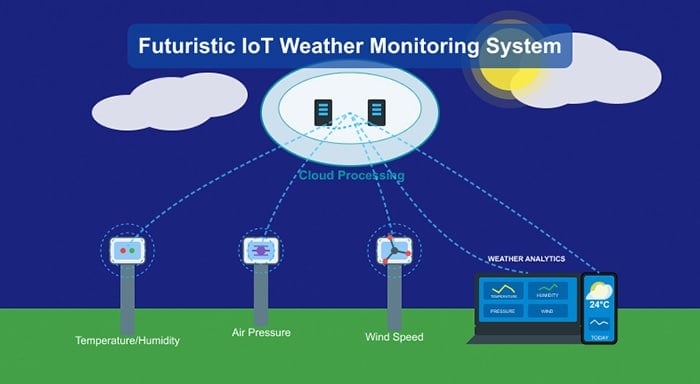 The sensor network forms the foundation of cloud-based weather monitoring, encompassing a mix of in-situ sensors (e.g., weather stations, anemometers) and remote sensing technologies (e.g., radar, satellites). Modern sensors incorporate edge computing capabilities, allowing preliminary data processing at the source to reduce bandwidth usage. For instance, AWS’s IoT Greengrass enables sensors to run local analytics, filtering irrelevant data before transmission. Data aggregation hubs, often deployed as edge gateways or fog computing nodes, consolidate streams from multiple sensors, applying protocols like MQTT (Message Queuing Telemetry Transport) to ensure efficient, low-power communication. These hubs also handle data validation to eliminate errors caused by sensor malfunctions or environmental interference.
Cloud servers act as the central nervous system of the system, hosting distributed databases (e.g., AWS DynamoDB, Google BigQuery) optimized for high-velocity data ingestion. These servers employ time-series databases (e.g., InfluxDB, TimescaleDB) to store historical weather patterns, enabling long-term trend analysis. Machine learning models, deployed via cloud services like Azure Machine Learning or Google AI Platform, process real-time data to generate forecasts, detect anomalies, or trigger alerts. For example, Google Cloud’s AutoML allows meteorological agencies to train custom models without extensive coding. APIs serve as the bridge between cloud infrastructure and end-user applications, providing structured access to weather data via RESTful or GraphQL interfaces. Developers integrate these APIs into platforms like NOAA’s Weather API or OpenWeatherMap to deliver hyper-localized forecasts to consumers or enterprises.
The sensor network forms the foundation of cloud-based weather monitoring, encompassing a mix of in-situ sensors (e.g., weather stations, anemometers) and remote sensing technologies (e.g., radar, satellites). Modern sensors incorporate edge computing capabilities, allowing preliminary data processing at the source to reduce bandwidth usage. For instance, AWS’s IoT Greengrass enables sensors to run local analytics, filtering irrelevant data before transmission. Data aggregation hubs, often deployed as edge gateways or fog computing nodes, consolidate streams from multiple sensors, applying protocols like MQTT (Message Queuing Telemetry Transport) to ensure efficient, low-power communication. These hubs also handle data validation to eliminate errors caused by sensor malfunctions or environmental interference.
Cloud servers act as the central nervous system of the system, hosting distributed databases (e.g., AWS DynamoDB, Google BigQuery) optimized for high-velocity data ingestion. These servers employ time-series databases (e.g., InfluxDB, TimescaleDB) to store historical weather patterns, enabling long-term trend analysis. Machine learning models, deployed via cloud services like Azure Machine Learning or Google AI Platform, process real-time data to generate forecasts, detect anomalies, or trigger alerts. For example, Google Cloud’s AutoML allows meteorological agencies to train custom models without extensive coding. APIs serve as the bridge between cloud infrastructure and end-user applications, providing structured access to weather data via RESTful or GraphQL interfaces. Developers integrate these APIs into platforms like NOAA’s Weather API or OpenWeatherMap to deliver hyper-localized forecasts to consumers or enterprises. Cloud-based systems outperform traditional on-premise deployments in cost efficiency, scalability, and maintenance, though trade-offs exist depending on use cases. The following table highlights key differences:
Leave a Comment
Comments are moderated before appearing. The data you submit is processed according to the Privacy Policy of Voltefac.